
Scratch Coding Program for Kids: From Blocks to Python
Most children learn to read before they write. They learn to count before they calculate. Coding works the same way, and a Scratch coding program gives children that gentle first step into this new language.
Scratch is a visual programming language from MIT that lets children build games, animations, and interactive stories by snapping together colorful code blocks. There is no typing, no confusing syntax, and no endless error messages. Instead, children focus on logic, creativity, and the instant thrill of seeing a character move because of their own instructions.
This article walks through what Scratch is, why it suits beginners so well, what kids actually learn in a structured class, and how MetaRobotics uses Scratch and robotics to build real coding foundations. MetaRobotics is built on the idea that learning is strongest when thinking and doing work together. The NEBULA™ Neuro-Builder model guides children through structured robotics and engineering challenges that build logic and long-term understanding. By the end, you will see how one small block can start a long-term tech path for your child in Singapore.
Key Takeaways
Key ideas from this guide help parents quickly understand why starting with a Scratch coding program makes sense for school-age children. These points also show how MetaRobotics turns early curiosity into real, long-lasting skills.
- Scratch removes typing and syntax barriers, so any curious child can focus on ideas instead of spelling every command correctly. This levels the field for children who may not love writing yet but enjoy puzzles and games. It also turns screen time into active creation rather than passive watching.
- Visual block-based coding builds real thinking skills such as sequencing, logic, and pattern spotting. These are the same habits needed later for Python and JavaScript, plus for topics like fractions and word problems in school. Scratch simply presents them in a playful, low-pressure format.
- A structured Scratch coding program, such as the NEBULA™ model at MetaRobotics, provides age-based pathways and measurable progress. Children move from simple games to robotics and then on to text-based code, with parents able to see clear outcomes at each stage. This makes enrichment spending feel targeted and worthwhile.
What Is Scratch Coding And Why Is It The Perfect Starting Point For Kids?

Scratch coding is the perfect starting point for kids because it uses colorful blocks to teach real programming logic without scary syntax. A Scratch coding program built on Scratch gives children safe, guided practice in the core habits that every coder needs later.
Scratch was created by the Lifelong Kindergarten Group at the MIT Media Lab to help children learn to think like programmers through play. Instead of typing every keyword, your child drags blocks such as “move 10 steps” or “if touching color” and snaps them together like virtual LEGO bricks. According to the Scratch Foundation, Scratch is now used in more than 200 countries and territories and is available in over 70 languages, showing how widely it fits young learners.
The best way to picture Scratch is as training wheels for code. Training wheels let a child feel the joy of cycling while their balance and confidence grow. In the same way, Scratch supports the “balancing” part of coding, so children can focus on ideas, logic, and creativity before handling punctuation, brackets, and exact spelling. When they are older, removing the training wheels and moving to Python feels far less scary.
Immediate feedback keeps this process exciting. When a child snaps a “when space key pressed” block above “play sound meow,” the cat sprite responds straight away. That clear cause and effect shows that real programming is already happening. For parents comparing enrichment options or a coding class in Singapore, Scratch gives a rare mix of low stress and high learning, which is why so many schools and centers choose it as the first step.
How Does A Scratch Coding Program Build Real Thinking Skills?
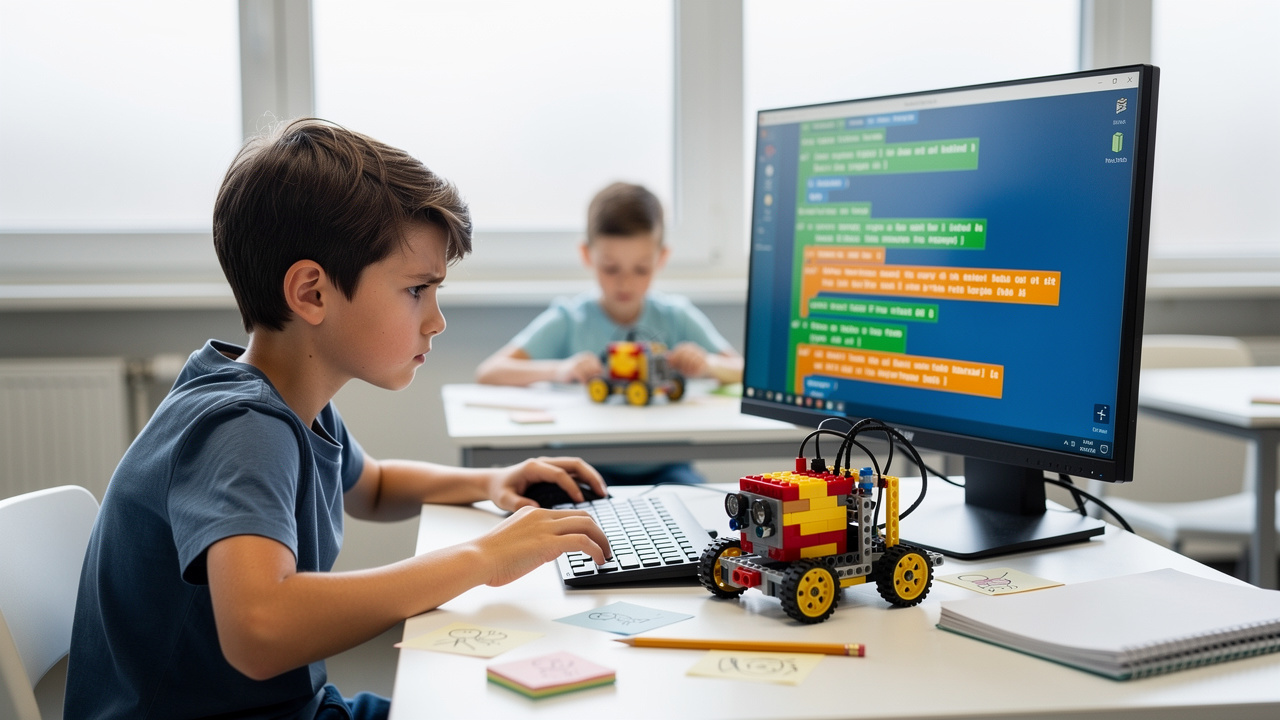
A Scratch coding program builds real thinking skills because every project asks your child to plan steps, test ideas, and adjust code. Behind the colorful blocks sits the same problem-solving process that supports math, science, and even composition writing.
Educators call this computational thinking, but for parents it simply means learning to break problems into clear, repeatable steps. Research from the National University of Singapore shows that early hands-on STEM experiences can raise innovation skills by about 30 percent and boost interest in STEM fields by around 40 percent, which is exactly what structured coding projects offer. Instead of just following instructions, your child learns to design them.
Four key thinking habits grow naturally during Scratch projects:
- Decomposition helps your child cut big problems into smaller tasks. Building a game might start with getting a character to move, then adding obstacles, then adding a score system. This teaches them to focus on one piece at a time, similar to solving a long math word problem step by step.
- Pattern recognition appears when children notice repeated actions. If a character needs to walk across the screen many times, your child soon replaces ten “move” blocks with one loop. Learning to see and reuse patterns makes homework and projects in other subjects feel more manageable and efficient.
- Abstraction means focusing on what really matters and hiding details. In Scratch, older students use “My Blocks” to pack a long stack of commands into a single custom block called things like “jump” or “reset level.” This mirrors how professional developers write clean, tidy code that is easy to read and fix.
- Algorithmic design is the habit of building step-by-step instructions that always work the same way. When a child decides what should happen “if” a sprite hits a wall or “else” continues moving, they are building a reliable process. That same careful thinking helps with science experiments and planning essays.
Debugging ties all these skills together. When the cat runs backward or a score does not change, students learn to test small changes, observe results, and keep going. In a kids coding programme where teachers frame bugs as puzzles instead of failures, children build patience and resilience that follow them far beyond the computer lab. MetaRobotics leans strongly on this idea, so students see challenges as part of the fun rather than a reason to give up.
What Do Children Actually Learn In A Structured Scratch Programme?
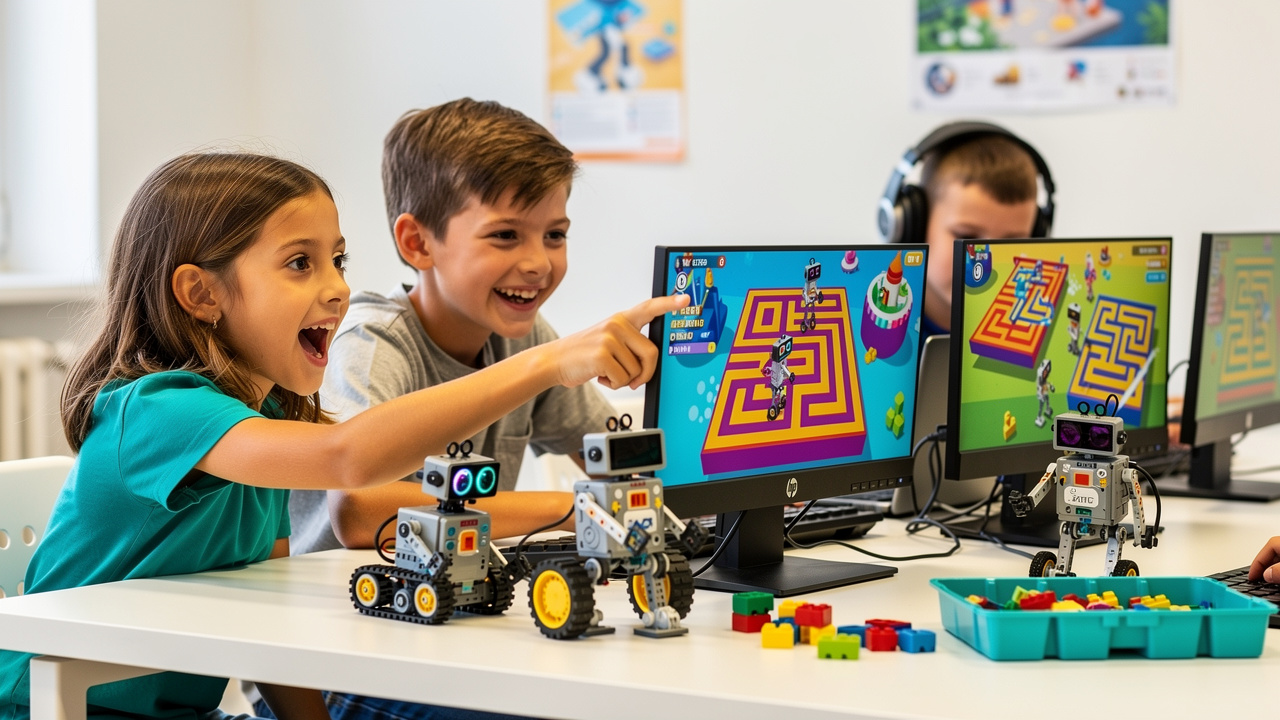
In a structured Scratch programme, children move through clear levels of projects that each teach a new concept and end with something they can proudly show. Instead of random clicking, a Scratch coding program sets goals for every lesson, which reassures parents that real skills are forming.
At MetaRobotics, lessons are grouped by age and experience, with each level ending in a completed game or animation — an approach supported by Analysis of scratch projects from introductory programming courses for primary school students. This means you can literally play through your child’s progress. Typical project paths look like this:
- Ages 8 to 10 often start with simple projects like Maze Starter and animated Greeting Cards. Students learn to move sprites with arrow keys, react to obstacles, and trigger sounds or messages. By the end of this stage, they understand basic sequencing, loops, and events such as “when green flag clicked.”
- Ages 10 to 12 move on to more advanced games such as Geometry Dash style runners and multi-level mazes. Here, children add variables to track scores and lives, use cloning for falling objects, and introduce gravity-like effects. This stage quietly teaches ideas similar to speed, acceleration, and chance, all while they chase high scores.
- Ages 11 and up build richer creations such as Spiral Make art generators or story-driven adventures that branch based on player choices. These projects lean on deeper logic, including nested conditions and more complex coordinate use. Many students in this range start linking Scratch projects with simple robotics tasks, which helps them see how software can control real hardware.
While children see “just a game,” many school topics sit under the surface:
- The Scratch stage is a coordinate grid, so every move teaches X and Y positions, positive and negative numbers, and angles — a connection explored in depth by research on Mathematical Thinking behind Coding, which shows how Scratch promotes generalization skills in mathematics.
- Boolean logic appears through blocks like “if,” “and,” and “or.”
- Ideas about randomness and probability show up in games that roll virtual dice or spawn objects at random.
According to the Ministry of Education Singapore, computational thinking and computer literacy stand as key twenty-first century competencies, and Scratch gives a very concrete way to practice both.
For families thinking about Direct School Admission (DSA), a steady stack of completed Scratch games and quizzes forms a real portfolio. When these projects come from a guided programme at MetaRobotics, they already show planning, documentation, and testing, which many secondary schools value when reviewing STEM or robotics applications. Children who learn Scratch in Singapore today are building evidence that may open academic doors tomorrow.
How MetaRobotics Structures Its Scratch Coding Program To Build Lasting Foundations

MetaRobotics structures its Scratch coding program so that thinking and doing always go hand in hand. MetaRobotics is built on the idea that learning is strongest when thinking and doing work together. The NEBULA™ Neuro-Builder model guides children through structured robotics and engineering challenges that build logic and long-term understanding. The goal is simple: grow strong logic habits, then connect them to real robots and, later, to text-based languages like Python.
The heart of this approach is the NEBULA™ Neuro-Builder model. Instead of just teaching commands, NEBULA™ guides children through repeating cycles of planning, building, testing, and improving. Younger students aged 5 to 7 begin with screen-free coding cards and simple robots, which keeps them active and avoids screen fatigue, an approach backed by Frontiers | Parental involvement in robot-mediated interventions, highlighting how guided, structured engagement improves learning outcomes for young children. Ages 8 to 12 work directly with MIT Scratch 3.0 while assembling robots from kits such as LEGO Education Spike Prime, so each block they snap on screen does something they can see and touch.
“When children see a robot move because of their ideas, coding stops feeling abstract and starts to feel powerful,” notes a MetaRobotics instructor.
For ages 11 and up, MetaRobotics classes use Scratch for rapid prototyping and then shift students into Python, JavaScript, and competitive robotics. Because the Scratch coding program already trained their logic using loops, variables, and conditions, students only need to learn the new “grammar” of typing. This smooth path helps them feel ready for more advanced work, including machine learning projects using platforms like Machine Learning for Kids.
Class design matters to results-driven parents in Singapore:
- MetaRobotics caps groups at about eight students per instructor, which keeps explanations personal and gives plenty of time for debugging together.
- The curriculum follows Ministry of Education themes, so concepts like angles, coordinates, and data connect directly to schoolwork.
- According to studies from the National University of Singapore, progress tracking with timely feedback can raise student motivation by around 40 percent, which is why MetaRobotics provides a parent app where you can review milestones and finished projects after each lesson.
Physical robotics is another key difference compared with a typical coding class in Singapore. Students might program a robot to follow a line, avoid obstacles with ultrasonic sensors, or sort objects by color. When code makes wheels turn or lights flash, abstract ideas suddenly feel real. A report from MIT Media Lab found that lessons combining online tools with hands-on making can improve problem-solving performance by roughly 30 percent, supporting this hands-and-minds-together style. For parents searching for a robotics class in Singapore that truly links code to the real world, this blend of Scratch and hardware is a strong fit.
Finally, MetaRobotics reduces much of the risk around enrichment choices through its “Fun or It’s Free” trial class. Families can see the NEBULA™ model, talk to instructors, and watch how their child responds before committing to a longer kids coding programme.
Wrapping Up: Your Child's Coding Path Starts With A Single Block

A Scratch coding program gives children the same safe start to programming that training wheels give to cycling. With visual blocks, friendly characters, and instant feedback, even a shy or unsure child can take the first step into coding and problem solving.
No prior experience is needed, and children as young as five can grow from screen-free logic games into full Scratch projects and then on to Python in their early teens. Any child who enjoys stories, puzzles, or building things can start learning Scratch. By choosing MetaRobotics, parents in Singapore place their child on a path where thinking and doing stay linked through the NEBULA™ Neuro-Builder model, from on-screen sprites to real robots. If you are curious, booking a “Fun or It’s Free” trial class is a simple way to see how your child responds when that very first block clicks into place.
Frequently Asked Questions
Question: What age should my child start a Scratch coding program?
Children can start a Scratch coding program as soon as they show curiosity about how games work. MetaRobotics welcomes ages 5 to 7 for screen-free foundations, while ages 8 to 12 are ideal for full Scratch 3.0 projects. There is no “too late,” because the curriculum adjusts to each child’s stage.
Question: Is Scratch coding considered “real” programming?
Yes, Scratch coding is considered real programming because it teaches the same logic as Python and JavaScript. Children work with loops, conditions, events, and variables, just in block form. Many universities and educators, including teams at MIT, recommend Scratch as the first formal step before text-based code.
Question: How long does it take to move from Scratch to Python?
Moving from Scratch to Python depends on your child’s pace and how consistent classes are. At MetaRobotics, students who have mastered Scratch logic usually move into beginner Python within the ages 11 to 14 pathway. The visual background from the Scratch coding program makes this shift feel natural.
Question: How is a coding class at MetaRobotics different from a regular coding class in Singapore?
A coding class at MetaRobotics differs from a typical coding class in Singapore by combining Scratch with real robotics and the NEBULA™ Neuro-Builder model. Classes stay small, with about eight students per instructor, and follow MOE themes. Parents can track progress in real time, and the “Fun or It’s Free” trial keeps the first step low risk.
Question: Does learning Scratch help with DSA applications for secondary school?
Learning Scratch can help with DSA because it supports a portfolio of working games, quizzes, and robotics projects. Top secondary schools often look for evidence of STEM interest and problem-solving skill. MetaRobotics students build collections of Scratch and robotics work that can support Direct School Admission under coding or robotics categories.