Introduction
When parents think about robotics classes for kids, they often picture children building robots, writing code and learning about technology. But one of the most valuable aspects of robotics education goes beyond the robots themselves: learning how to solve problems.
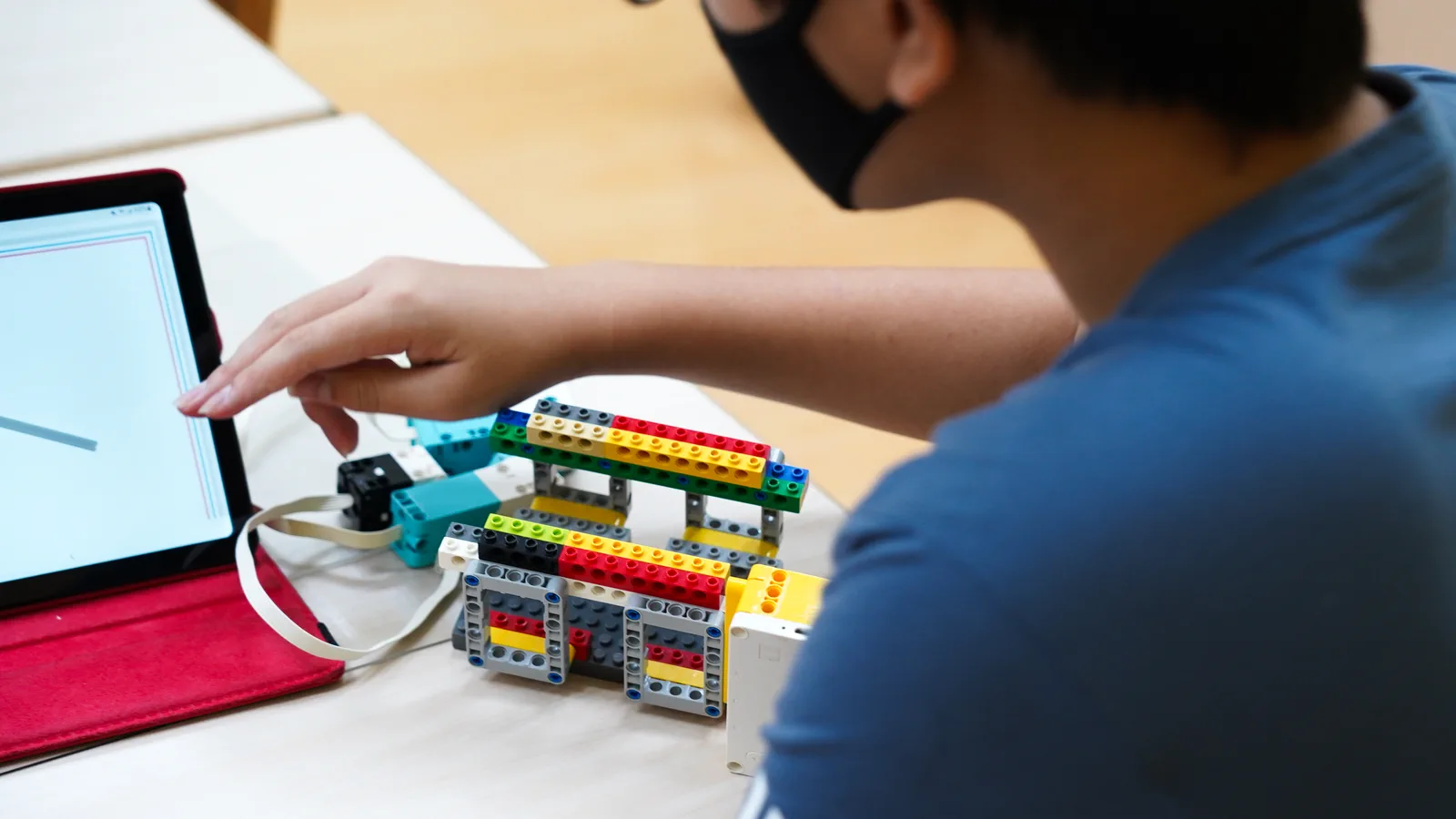
Imagine a child programming a robot to navigate around an obstacle. The robot moves forward, turns in the wrong direction and crashes into a wall. Instead of being given the correct answer immediately, the child is encouraged to investigate what went wrong, adjust the instructions and try again.
This simple experience introduces an important way of thinking: understanding a problem, testing possible solutions and learning from the results.
In this article, we explore how robotics helps children practise problem-solving skills, why these skills matter and what parents can look for in a meaningful robotics learning experience.
Why Are Problem-Solving Skills Important for Children?
Problem-solving is the ability to recognise a challenge, understand what needs to be done and work towards a solution.
Children use these skills in many everyday situations, whether they are working through a difficult maths question, organising a group project or figuring out why something they have built does not work as expected.
Effective problem-solving often involves several related abilities:
- Logical thinking: Understanding relationships between actions and outcomes.
- Critical thinking: Questioning assumptions and evaluating possible solutions.
- Creativity: Exploring different approaches instead of relying on a single answer.
- Perseverance: Continuing to work through difficulties.
- Reflection: Learning from mistakes and improving future decisions.
These skills are valuable beyond technology. They help children become more confident in approaching unfamiliar challenges rather than simply waiting for instructions.
How Does Robotics Develop Problem-Solving Skills?
Robotics creates opportunities for children to apply their thinking to physical challenges. Unlike exercises where answers exist only on paper, a robot provides visible feedback.
When a robot behaves differently from what a child expected, there is an opportunity to investigate why.
Here are five ways robotics activities can support problem-solving development.
1. Breaking Complex Problems into Smaller Steps
A challenging task can feel overwhelming when approached all at once.
Consider a robot that must travel through a maze. Instead of solving the entire maze immediately, a child can divide the challenge into smaller steps:
- Move forward to the first turning point.
- Turn in the correct direction.
- Travel to the next obstacle.
- Repeat until the destination is reached.
This process is known as decomposition, an important concept in computational thinking.
By breaking a larger challenge into manageable parts, children learn to approach problems more systematically.
The same principle can be useful when planning a school project, preparing for an examination or organising a complicated task.
2. Developing Logical and Sequential Thinking
Robots follow instructions in a defined sequence. If the instructions are incorrect or arranged in the wrong order, the robot may not behave as intended.
For example, a child might programme a robot to pick up an object and then move to another location.
However, if the robot moves before gripping the object, the task fails.
The child must consider the relationship between each instruction and the desired outcome.
Through these activities, children practise asking questions such as:
- What needs to happen first?
- What happens if I change this instruction?
- Why did the robot behave differently from what I expected?
Over time, these experiences can help children become more deliberate about planning and sequencing their actions.
3. Learning Through Trial, Error and Debugging
One of the most useful lessons in robotics is that getting something wrong can be part of learning.
A robot rarely performs every new challenge perfectly on the first attempt. There may be an incorrect instruction, an unstable structure or a sensor that is not responding as expected.
Instead of starting over without understanding the problem, children can learn to debug.
Debugging involves identifying the source of an error, making a targeted adjustment and testing whether the change works.
For example, if a robot turns too far, a child might reduce the turning duration or motor rotation and observe the result.
This encourages a more thoughtful approach than repeatedly guessing.
It also helps children understand that mistakes provide useful information, rather than simply indicating failure.
4. Encouraging Creativity and Experimentation
Many robotics challenges have more than one possible solution.
Two children might be asked to design a robot that can transport a small object. One may create a gripping mechanism, while another develops a platform that carries the object.
Both approaches could work, even though the designs are different.
This creates opportunities for children to experiment, compare ideas and understand the trade-offs between different solutions.
A design that moves faster may be less stable. A stronger mechanism may require additional components.
Children learn that solving problems is not always about finding one predetermined answer. Sometimes, it involves exploring possibilities and making informed decisions.
5. Building Perseverance and Confidence
Robotics challenges can require multiple attempts before a solution works.
A structure may collapse. A robot may miss its target. A programme may contain an error that is difficult to identify.
With appropriate guidance, children can learn to respond to these setbacks by adjusting their approach instead of giving up immediately.
Completing a challenge after several attempts can provide a sense of achievement.
Importantly, perseverance does not mean leaving children to struggle without support. Effective educators provide encouragement, appropriate hints and guidance that helps learners make progress independently.
A Simple Example: Teaching a Robot to Navigate a Maze
Consider a beginner robotics activity where children must programme a robot to travel from a starting point to a designated destination.
The problem-solving process
- Understand: Identify the destination and obstacles.
- Plan: Decide the sequence of movements.
- Build and programme: Translate the plan into instructions.
- Test: Observe how the robot moves.
- Improve: Identify errors and refine the programme.
Even a relatively simple activity like this can involve planning, logical reasoning, experimentation and reflection.
The educational value is not just whether the robot reaches its destination. It is also how the child approaches the challenge along the way.
What Does Research Say About Robotics and Problem-Solving?
Research suggests that educational robotics can support the development of computational thinking and related problem-solving abilities when activities are designed appropriately.
A systematic review by Ching and Hsu examined 22 empirical studies involving young learners and identified sequencing, conditional logic, loops, debugging and algorithmic thinking among the most frequently studied computational thinking skills.
A separate systematic review and meta-analysis published in Computers & Education also reported positive findings for problem-solving outcomes in computational thinking interventions, including structured educational robotics activities.
However, robotics participation alone does not guarantee improvements in every thinking skill. Outcomes depend on factors such as teaching methods, the child's developmental stage, activity design and opportunities for reflection.
The important consideration for parents is therefore not simply whether a class uses robots, but how children are encouraged to think while using them.
What Should Parents Look for in a Robotics Class?
Not all robotics activities provide the same learning experience.
Some activities focus primarily on following step-by-step instructions to assemble a model. While these can introduce useful building and technical skills, children also benefit from opportunities to investigate, experiment and make decisions independently.
When evaluating a robotics class, parents can consider the following questions:
- Are children encouraged to explain their ideas and decisions?
- Do activities include challenges with opportunities for experimentation?
- Are children guided to identify mistakes rather than immediately being given the answers?
- Does the difficulty progress as children develop their abilities?
- Do educators provide feedback on the child's thinking process, not just the completed robot?
A well-designed programme should balance appropriate guidance with opportunities for independent thinking.
How Parents Can Encourage Problem-Solving at Home
Parents do not need expensive robotics equipment to reinforce the thinking habits children practise during robotics lessons.
Everyday activities can provide similar opportunities.
For example, parents can invite children to design a simple obstacle course, build a bridge using household materials or work out the most efficient way to organise their toys.
Instead of immediately correcting a mistake, try asking:
- "What do you think caused that?"
- "What could we try differently?"
- "How can we test your idea?"
- "What did you learn from this attempt?"
These questions encourage children to explain their reasoning and take an active role in finding solutions.
The goal is not to make every activity difficult. It is to create a supportive environment where children feel comfortable exploring ideas and learning from mistakes.
How Meta Robotics Encourages Problem-Solving
At Meta Robotics, we believe robotics education should go beyond assembling models or following coding instructions.
Our learning approach combines hands-on activities with age-appropriate challenges that encourage children to think, experiment and improve.
Through our NEBULA™ learning model, children are introduced to progressively more challenging concepts while building on their previous learning experiences.
Whether they are exploring basic mechanisms, programming movements or tackling more advanced robotics challenges, the objective is to develop not only technical familiarity but also the thinking processes behind their solutions.
Our robotics and coding programmes are designed for different age groups and learning stages, helping children progress at an appropriate pace.
Frequently Asked Questions
At what age can children start learning problem-solving through robotics?
Children can begin exploring basic problem-solving concepts from a young age through age-appropriate building, sequencing and hands-on activities. At Meta Robotics, our programmes begin from age 3, with activities adapted to different developmental stages.
Does my child need coding experience to learn robotics?
No. Beginner robotics activities can introduce foundational concepts without requiring prior coding knowledge. Children can progress towards more advanced programming as their understanding develops.
Is robotics better than coding for developing problem-solving skills?
Both can provide valuable learning opportunities. Robotics combines programming with physical construction and real-world feedback, while coding can focus more directly on computational logic and software-based challenges. The best choice depends on the child's interests, age and learning objectives.
Will robotics improve my child's academic performance?
Robotics can provide opportunities to practise logical reasoning, planning and problem-solving. However, improvements in academic performance are not guaranteed. The benefits depend on the quality of instruction, the child's engagement and how the skills are applied in other settings.
How can I tell whether my child is developing problem-solving skills?
Look beyond whether a robot works correctly. Observe whether your child can explain what went wrong, suggest alternative approaches, test ideas and reflect on the outcome. These behaviours can provide useful indications of developing problem-solving habits.
Conclusion: Learning to Think Beyond the Robot
Robotics education is about more than building machines or learning to programme.
At its best, it gives children opportunities to ask questions, experiment with ideas, overcome challenges and develop confidence in their own thinking.
The robot is a tool. The deeper learning happens when children discover how to approach problems, evaluate solutions and improve through experience.
These are skills that can remain valuable long after a robotics lesson has ended.
Discover Robotics and Coding at Meta Robotics
Explore our age-appropriate robotics and coding programmes and discover how hands-on learning can help your child develop technical skills alongside creativity, logical thinking and problem-solving abilities.