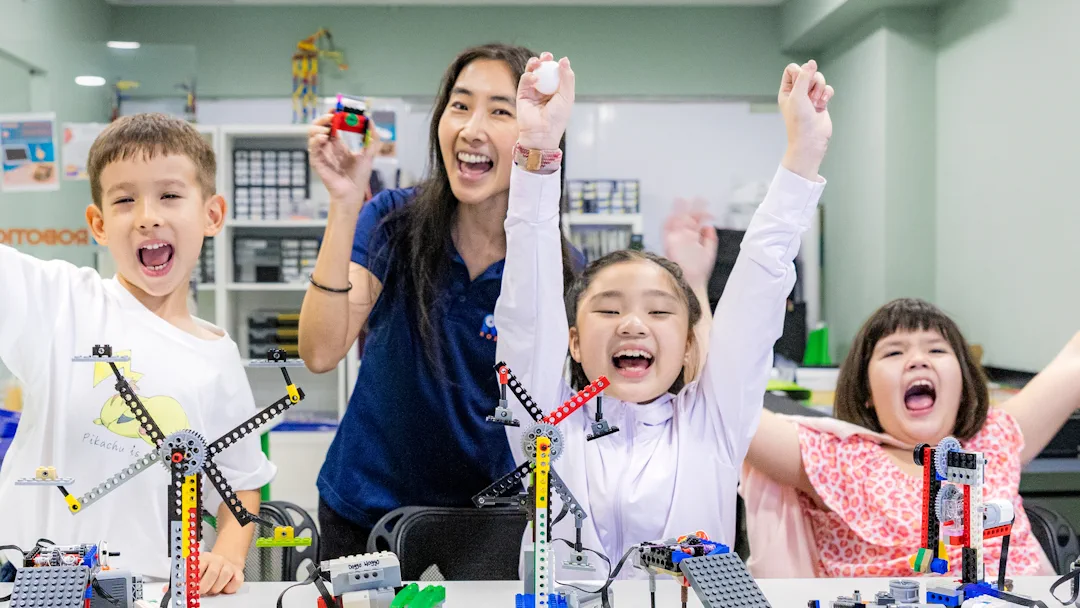
Robotics classes are becoming a popular enrichment option for children in Singapore. But with so many programmes offering robotics, coding, STEM activities and competition training, how do you know which one is right for your child?
Should children start as early as preschool? Is robotics different from coding? And how can parents tell whether a class is helping their child learn, rather than simply teaching them to follow instructions?
This guide explains what children can learn through robotics, what to look for at different ages, and how to choose a programme that suits your child's interests and learning needs.
What do children actually learn in robotics classes?
A good robotics class involves more than building a robot that moves.
Depending on the child's age and experience, lessons may combine engineering, coding, mathematics, science and design through practical activities.
For example, a child might build a small vehicle, programme it to move forward, and then discover that it cannot travel in a straight line.
Instead of simply correcting the problem for the child, a teacher might ask:
- What do you think is causing the vehicle to turn?
- Are both wheels moving at the same speed?
- What could you change to test your idea?
- Did your adjustment improve the result?
This is where robotics becomes a learning experience rather than just an assembly activity.
Children have opportunities to practise several skills.
Logical thinking: Breaking a larger challenge into smaller steps and understanding how instructions affect a robot's behaviour.
Problem-solving: Identifying why something isn't working, testing possible solutions and learning from unsuccessful attempts.
Creativity: Exploring different designs and discovering that a challenge may have more than one solution.
Spatial reasoning: Understanding how individual components fit together to form a functioning model.
Communication and collaboration: Explaining ideas, discussing problems and working with others when activities involve teams.
These are potential learning benefits, not automatic outcomes. Much depends on the curriculum, teaching approach and opportunities children have to think independently.
What is the best age to start robotics?
There is no single ideal age to begin robotics.
A suitable starting point depends on your child's interests, fine motor skills, ability to follow instructions and readiness to explore challenges.
The learning experience should change as children grow.
| Age | Suitable learning approach | What parents can look for |
|---|---|---|
| 3–4 years | Guided building, simple mechanisms and hands-on exploration | Curiosity, coordination, recognising patterns and cause and effect |
| 5–6 years | Simple construction challenges, sequencing and introductory visual coding | Following logical steps, making predictions and explaining simple ideas |
| 7–9 years | Building and programming functioning robots, testing and improving designs | Increasing independence, debugging and structured problem-solving |
| 10–12 years | More complex engineering challenges, coding and project-based learning | Planning, experimentation, design decisions and explaining solutions |
| 13 years and above | Advanced projects matched to interests and experience | Deeper technical understanding, independent projects and specialised interests |
These age ranges are general guidelines, not universal requirements.
Is three or four too young for robotics?
Not necessarily, provided the activities are developmentally appropriate.
At this age, robotics education should look more like purposeful play than formal programming.
Children might explore how gears turn, how wheels move or how different parts connect. They should have opportunities to experiment with physical objects rather than spend most of the lesson looking at a screen.
Parents should not expect preschoolers to master complex programming concepts.
A more realistic objective is to nurture curiosity, coordination and the confidence to try something new.
What if my child starts at nine or ten?
That's perfectly fine too.
Children do not need years of robotics experience before they can benefit from a class.
An older beginner may be able to progress through introductory concepts more quickly because of stronger reading, reasoning and problem-solving abilities.
The important consideration is placement. A ten-year-old beginner should not automatically be placed in an advanced class simply because of age, nor should they be given activities that feel unnecessarily childish.
Look for a programme that considers both age and experience.
Robotics vs coding: which is better for your child?
Robotics and coding are closely related, but they are not identical.
Coding focuses on creating instructions that a computer or digital system can execute. Children may learn through animations, games, interactive stories or software projects.
Robotics combines physical construction with programming and engineering concepts. Children can observe how their instructions affect a real-world object.
For example, in a coding class, a child might programme an animated character to navigate a maze.
In a robotics class, the child might programme a physical robot to navigate a course.
Both can involve sequencing, logical thinking, testing and debugging.
The difference is largely in how children experience the result.
| Robotics classes | Coding classes |
|---|---|
| Often combine physical building and programming | May focus more on software and digital projects |
| Provide physical feedback through movement, motors and sensors | Provide feedback through games, animations or applications |
| Introduce engineering and mechanical design concepts | Can offer deeper exploration of programming concepts |
| May appeal to children who enjoy constructing and experimenting | May appeal to children who enjoy creating digital experiences |
Neither approach is inherently superior.
Some children enjoy both, while others develop a stronger interest in one area.
If you're unsure, look for an introductory experience that allows your child to try hands-on robotics before committing to a longer programme.
How to choose a good robotics class in Singapore
A robotics programme can look impressive in photographs or promotional videos. But attractive equipment and elaborate robot models do not necessarily indicate good teaching.
Here are six factors worth considering.
1. Does the curriculum match your child's ability?
Ask how students are grouped and how the programme accommodates beginners.
An age-appropriate class should provide achievable challenges while leaving room for exploration.
If your child already has experience, ask how the centre assesses their existing skills and whether they can progress beyond introductory projects.
2. Are children encouraged to think independently?
This is one of the most important questions.
There is a difference between completing a robot by following instructions and understanding why the robot works.
Building instructions can be useful, especially for beginners. But learning should not end once the model is assembled.
A good teacher should create opportunities for children to predict outcomes, experiment, troubleshoot and explain their decisions.
For example, after building a robot, students might be challenged to make it move faster, turn more accurately or perform a different task.
That additional challenge can reveal whether they understand the underlying concepts.
3. How much guidance does the teacher provide?
Young learners need guidance. However, excessive intervention can remove opportunities to solve problems independently.
Observe whether teachers ask questions and offer hints before providing answers.
The objective is not to leave children struggling without support. It is to help them develop the confidence to attempt solutions themselves.
Ask about class size and the typical instructor-to-student ratio. Smaller groups can make individual attention easier, but teaching quality and classroom organisation matter too.
4. Is there a clear learning progression?
Some programmes focus on individual workshops, while others provide a structured pathway over several years.
Both have value.
A holiday workshop can be a useful introduction, especially for children exploring robotics for the first time.
A regular programme may be more suitable if your goal is to develop skills progressively.
For longer-term learning, ask how the curriculum evolves.
Will your child encounter increasingly challenging engineering problems? Will coding become more sophisticated? Will they eventually design or modify projects more independently?
A good progression should involve more than simply building larger or more complicated robots.
5. Does the programme provide meaningful feedback?
Parents should be able to understand what their child is learning.
A completed robot is tangible evidence of an activity, but it doesn't necessarily demonstrate how much the child understood.
Useful feedback might explain:
- Which concepts the child has understood
- How independently they approached the challenge
- What difficulties they encountered
- How they responded when something didn't work
- What skills they should develop next
The most useful feedback focuses on the learning process, not only the finished product.
6. Does the programme fit your family's routine and budget?
Practical considerations matter, especially for regular enrichment.
Check the lesson duration, frequency, centre location, fees and commitment period.
Also ask whether equipment and materials are included, how replacement lessons work, and whether there are additional costs for special programmes or competitions.
A programme that fits your child's interests but creates constant scheduling stress may not be sustainable.
Seven questions to ask before enrolling
You don't need technical knowledge to evaluate a robotics class.
These questions can help you understand how a programme works:
- How do you decide which level is suitable for my child?
- How much of each lesson involves independent thinking versus following instructions?
- What happens when a child cannot solve a challenge?
- How does the curriculum progress over six months or a year?
- How do you communicate progress to parents?
- What is included in the fee, and what additional costs might arise?
- Can my child experience a class or assessment before we commit?
Pay attention to how clearly the centre answers.
A good provider should be able to explain its teaching approach in language parents understand, without relying entirely on technical jargon or competition achievements.
What progress should parents realistically expect?
Robotics learning is not always linear.
A child may complete an impressive model one week and struggle with a seemingly simple challenge the next.
This doesn't necessarily mean they are falling behind.
Rather than measuring progress only by the complexity of the robot, look for changes in how your child approaches problems.
For example, over time, you might notice that your child:
- Tries another approach instead of giving up immediately
- Explains why a robot behaved unexpectedly
- Checks their own work before asking for help
- Suggests modifications to improve a design
- Becomes more comfortable discussing mistakes
- Shows curiosity about how everyday mechanisms work
These are useful signs to observe, although individual progress varies.
Parents can reinforce this learning at home with simple questions:
What was the hardest part of today's lesson?
What did you try when it didn't work?
If you could improve your robot, what would you change?
These conversations encourage children to reflect on the process rather than focus exclusively on success or failure.
Should your child join robotics competitions?
Not necessarily.
Competitions can provide valuable opportunities for children who enjoy robotics and want to tackle more demanding challenges.
Depending on the event, students may need to design, programme, test, present and improve their work under specific rules or time constraints.
However, competitions should not be the only measure of a good robotics education.
Some children thrive in competitive environments. Others benefit more from exploratory projects without the pressure of rankings.
For beginners, developing curiosity, confidence and foundational skills may be a better initial priority.
If your child later develops a strong interest, you can explore competition pathways and ask whether the programme provides suitable preparation.
Taking the first step with robotics
If your child has never attended a robotics class, there's no need to commit immediately to an advanced or long-term programme.
Start by understanding what interests them.
Do they enjoy building things? Solving puzzles? Creating games? Experimenting with how objects move?
A short introductory session, workshop or structured assessment can help you observe their response to robotics activities.
Look beyond whether they enjoyed the lesson.
Did they ask questions? Did they try to solve problems? Were they comfortable receiving guidance? Did the challenge feel appropriately difficult?
These observations can help you decide whether regular robotics learning would be a good fit.
And if your child isn't interested yet, that's fine. Robotics is one possible enrichment pathway, not a compulsory subject every child must pursue.
How Meta Robotics approaches robotics education
For parents exploring structured robotics enrichment in Singapore, Meta Robotics offers age-based learning programmes that combine hands-on robotics, coding and STEM activities.
Its regular learning pathway includes:
- Adapter (ages 3–4): Early hands-on exploration and foundational learning
- Ranker (ages 5–6): Introductory robotics and coding concepts
- High-Ranker (ages 7–9): Progressive building, coding and problem-solving activities
- Ace (ages 10–12): More advanced robotics, coding and applied learning
- King (ages 13 and above): Further development through age-appropriate advanced topics
The aim is to offer a progression suited to children's growing capabilities rather than treating robotics as a series of disconnected activities.
Parents who are unsure where to begin can explore the programmes or consider a Robotics Discovery Assessment, which is designed to help identify a suitable starting point.
The right choice ultimately depends on your child's interests, readiness and learning needs.
Explore Meta Robotics programmes: https://www.metarobotics.sg/programmes
Learn about the Robotics Discovery Assessment: https://www.metarobotics.sg/rda
Frequently asked questions
Are robotics classes suitable for children who have never coded?
Yes. Many introductory robotics programmes are designed for complete beginners. Children can begin with construction, sequencing and visual programming before progressing to more advanced concepts.
Does my child need to be good at mathematics?
No. Children do not need advanced mathematical knowledge to begin age-appropriate robotics activities. Some robotics tasks introduce mathematical ideas through practical experiences, with complexity increasing as students progress.
Are robotics classes mostly screen-based?
It depends on the programme. Some activities involve programming on a computer or tablet, while others focus on building, testing and physical experimentation. Parents should ask how a typical lesson balances these activities.
How long does it take to learn robotics?
There is no fixed timeline. A child may understand introductory concepts within a few lessons, while developing independent design, programming and troubleshooting skills can take considerably longer.
Is robotics better than traditional enrichment classes?
Not necessarily. Robotics can be a good fit for children interested in building, technology and problem-solving. Other enrichment activities may better match different interests and developmental needs. The best choice depends on the child and the family's priorities.