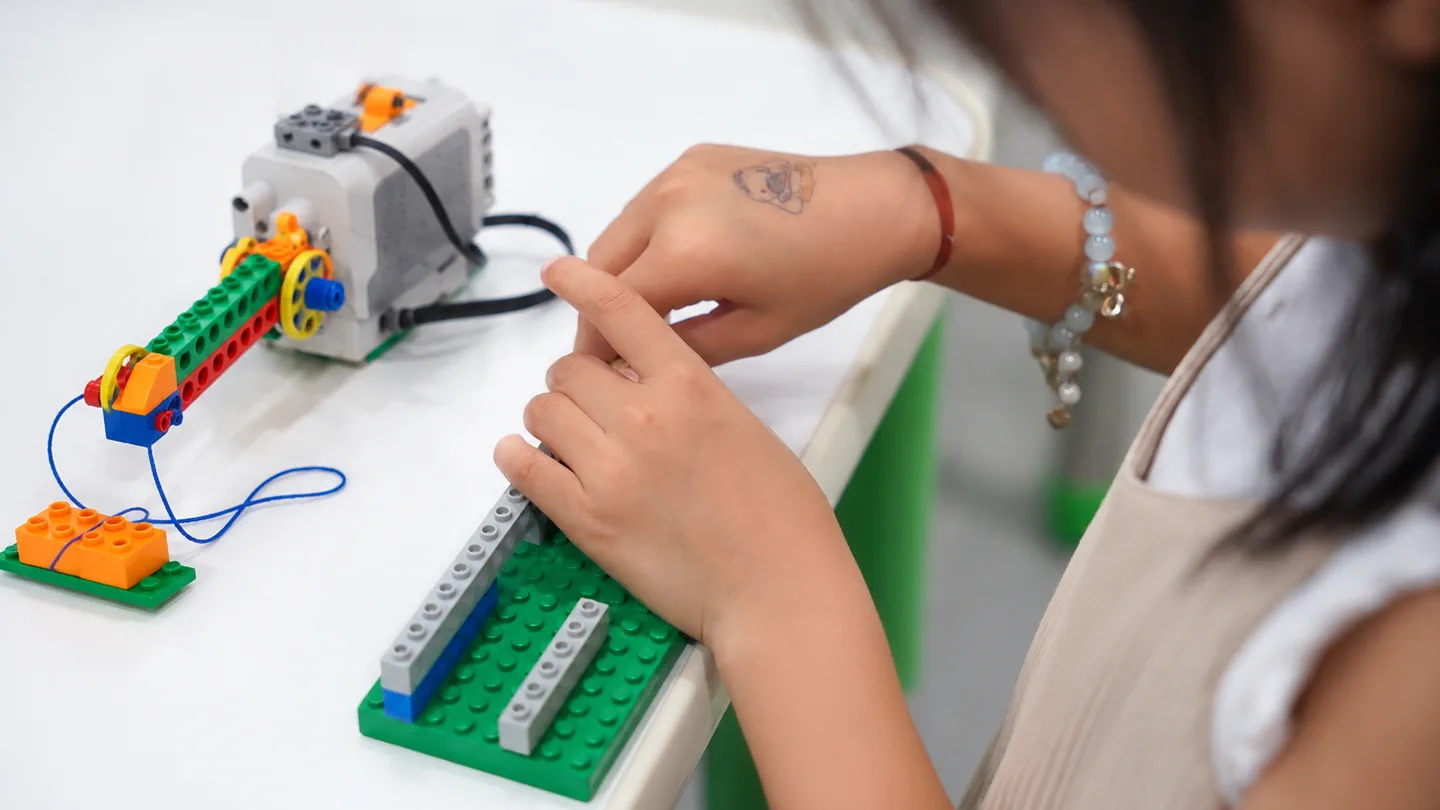
STEM education is becoming an increasingly familiar term among parents in Singapore. From robotics and coding classes to science workshops and engineering challenges, there are more opportunities than ever for children to explore STEM.
But what exactly is STEM education? Does your child need to be good at mathematics or science to benefit? And how do you choose a programme that offers meaningful learning rather than simply another enrichment activity?
The good news is that STEM education does not have to begin with complicated technology or advanced academic knowledge. It can start with building a bridge from paper, figuring out why a toy car will not move, or experimenting with different ways to solve a puzzle.
This guide explains what STEM education means, how it can benefit children, and what Singapore parents should consider when introducing STEM learning.
What is STEM education?
STEM stands for four interconnected areas of learning:
- Science: Understanding how the world works through observation, questions and experiments.
- Technology: Using tools and digital systems to solve problems or achieve goals.
- Engineering: Designing, building, testing and improving solutions.
- Mathematics: Using numbers, patterns, measurements and logical reasoning.
What makes STEM education particularly interesting is how these disciplines can work together. A child building a small robot that follows a line may explore how sensors detect the line, programme its movements, adjust its physical design, and use distance or timing to improve its performance. Instead of learning each subject in isolation, the child applies several areas of knowledge to solve one practical problem.
Why is STEM education important for children?
STEM education is often associated with future technology-related careers, but its more immediate value lies in the thinking habits children can practise through hands-on learning.
1. Developing problem-solving skills
When a robot keeps turning in the wrong direction, children can investigate possible causes: a motor connection, an instruction in the programme, or a wheel moving differently. Identifying possible causes and testing changes helps them break larger problems into manageable parts.
2. Encouraging critical thinking
STEM activities let children ask questions, compare alternatives and explain decisions. When testing paper-bridge shapes, for example, they can observe results and use evidence to improve a design rather than simply guessing.
3. Building creativity
Engineering and technology challenges often allow many possible solutions. When children can experiment rather than follow a fixed model every time, they have more opportunities to develop original ideas.
4. Learning perseverance
A structure may collapse, a robot may miss its target, or a programme may produce an unexpected result. In a supportive environment, these moments can become opportunities to reflect and try again.
5. Practising communication and teamwork
Many STEM projects involve discussing ideas, dividing responsibilities, explaining designs and listening to feedback. These activities can provide opportunities to practise communication alongside technical skills.
At what age should children start STEM education?
There is no single ideal starting age. Children can explore STEM concepts long before they are ready to write code or understand complex engineering principles. The key is choosing activities that match their developmental stage, interests and confidence.
| Age | Suitable STEM experiences |
|---|---|
| 3–4 years | Building blocks, sorting, patterns, and simple cause-and-effect activities |
| 5–6 years | Guided construction, sequencing, simple mechanisms and introductory robotics |
| 7–9 years | Structured robotics challenges, beginner coding, testing and improving designs |
| 10–12 years | More independent programming, engineering projects and multi-step challenges |
| 13+ years | Advanced robotics, programming, complex problem-solving and specialised projects |
These are broad guidelines, not strict requirements. For younger children, play-based exploration is often more appropriate than lengthy explanations or formal programming lessons. Older children may enjoy increasingly open-ended projects where they make more decisions independently.
A useful principle: Start with curiosity and hands-on exploration, then introduce greater technical complexity as your child becomes ready.
What does STEM learning look like in practice?
STEM education does not require expensive equipment or sophisticated laboratories. Many useful activities begin with everyday objects.
Activity 1: Build a paper bridge
Suitable for: Approximately ages 5–9, with adult guidance. Give your child paper, tape and two supports such as books. Challenge them to build a bridge that can hold several small objects. Try folding the paper into different shapes and compare which design supports more weight.
Activity 2: Create a marble maze
Suitable for: Approximately ages 6–10. Use cardboard, paper strips and tape to create a maze. If the marble gets stuck, encourage your child to identify the problem and redesign part of the maze.
Activity 3: Explore coding without a computer
Suitable for: Approximately ages 5–8. Create a simple grid on the floor. One person acts as a robot while another gives precise instructions, such as moving forward two squares or turning right. This introduces the idea of algorithms and sequencing.
Activity 4: Build and programme a robot
Suitable for: Children ready for structured robotics activities. Using an age-appropriate kit, challenge your child to build a robot that moves a particular distance or completes a simple task. After the first attempt, ask what could be improved.
How are robotics and coding related to STEM education?
Robotics and coding are popular ways to introduce STEM, but they are not identical. Coding focuses primarily on creating instructions for computers or digital systems; children might build animations, games or simple programmes. Robotics combines programming with physical construction, mechanisms and sensors.
Both can support STEM learning, but the best choice depends on a child's interests. A child who enjoys storytelling and digital games might be drawn to coding, while a child who loves building and seeing objects move might prefer robotics. Neither is automatically better.
For a broader comparison, see our guide to robotics classes for kids in Singapore.
Is STEM education just more screen time?
Not necessarily. Some STEM activities involve computers or tablets, but many are completely screen-free. Even technology-based activities can include physical building, discussion, planning and testing away from a screen.
For parents, the more useful question is what a child is doing with technology. There is a meaningful difference between passively watching videos and actively creating a programme, testing an idea or explaining how something works. Educational screen use still benefits from age-appropriate limits, breaks and a healthy balance with physical play, reading and social activities.
How to choose a STEM programme in Singapore
The best choice is not necessarily the programme with the most advanced equipment or the most impressive-looking projects. Consider these six areas when comparing options.
1. Age-appropriate learning
Check whether the programme matches your child's experience and developmental stage. Beginners should not be expected to understand complex programming concepts immediately, while experienced children should have opportunities to progress.
2. Hands-on participation
Ask how much time children spend actively building, experimenting, programming or solving problems. Demonstrations can be useful, but children also need opportunities to make decisions and test their ideas.
3. A structured learning progression
Individual workshops can be enjoyable, but a longer-term programme should have a clear progression. Ask how lessons build on previous knowledge and what children can reasonably explore as they advance.
4. Opportunities for independent thinking
Watch how instructors respond when a child encounters difficulty. Guidance is important, especially for younger learners, but children should also have opportunities to investigate and think for themselves.
5. Appropriate class support
Class size alone does not determine teaching quality. Consider whether instructors can observe progress, respond to questions and support learners who need additional help.
6. Meaningful progress updates
A completed model or certificate can be a nice achievement, but feedback about what a child is learning and where they can improve is often more informative.
Seven questions to ask before enrolling
- What will my child actually do during a typical lesson?
- How is the programme adapted for different ages and abilities?
- Will my child build or programme independently, or mainly follow instructions?
- How do instructors support children when something goes wrong?
- What does progression look like over six months or a year?
- How will I know whether my child is improving?
- Can my child experience a lesson or assessment before committing to a longer programme?
Does my child need to join robotics competitions?
No. Competitions are not required for children to benefit from STEM education. Some children enjoy preparing for an event, working with teammates and presenting ideas; others prefer exploring projects at their own pace. Participation should be based on readiness and interest, not treated as the only measure of success.
How parents can encourage STEM learning at home
You do not need to be an engineer or programmer to support your child's interest in STEM. Ask thoughtful questions when something does not work:
- What do you think happened?
- What could we try differently?
- How can we test that idea?
- What did you discover?
- If you built it again, what would you change?
You can also involve children in everyday problem-solving, such as measuring ingredients, organising objects, planning a route or designing a simple household solution.
Exploring STEM through robotics at Meta Robotics
At Meta Robotics, robotics provides a hands-on way for children to explore STEM concepts through building, coding and problem-solving. Our programmes are organised around different age groups and learning stages:
- Adapter (ages 3–4): Early exploration, basic construction and foundational thinking skills.
- Ranker (ages 5–6): Guided robotics activities, sequencing and introductory problem-solving.
- High-Ranker (ages 7–9): Structured robotics challenges, programming concepts and design improvement.
- Ace (ages 10–12): More advanced robotics, programming and engineering challenges.
- King (ages 13+): Further development through more complex robotics and technical projects.
The aim is to help children progress at an appropriate pace while developing confidence in experimenting, reasoning and solving problems. Parents can explore our robotics programmes or learn about the Robotics Discovery Assessment to identify a suitable starting point.
Frequently asked questions
Is STEM education suitable for children who are not strong in mathematics?
Yes. STEM activities can provide practical opportunities to explore patterns, measurements and logical reasoning. A child does not need to excel academically in mathematics before trying age-appropriate STEM activities.
What is the difference between STEM education and robotics classes?
STEM education covers science, technology, engineering and mathematics. Robotics is one way to combine several of these areas through physical construction and programming.
Can preschool children learn STEM?
Yes. Preschool STEM can involve building, sorting, observing, experimenting and exploring cause and effect. Activities should be playful and suited to a child's developmental stage.
Are STEM enrichment classes necessary?
No. Children can explore STEM through school activities, play, books, experiments and everyday experiences. Enrichment classes may provide additional structure, equipment, guidance and progression, but they are not the only way to learn.
How do I know whether a STEM programme is helping my child?
Look beyond completed projects. Notice whether your child is asking more questions, explaining ideas, experimenting with alternatives and becoming more comfortable working through challenges. Progress may be gradual and differs between children.
Final thoughts
STEM education is not simply about preparing children to become programmers, scientists or engineers. It is also about giving them opportunities to ask questions, explore ideas, solve problems and learn through experimentation. For Singapore parents, the best starting point is an experience that matches a child's interests, encourages active participation and helps them develop confidence in learning.