
STEM Education Program Guide for Parents
Parents and business owners often hear that a strong STEM education program shapes a child’s future, yet the details can feel fuzzy. That confusion grows when every school and enrichment centre claims to be “future‑ready.”
A STEM education program brings science, technology, engineering, and math together in real projects that mirror real jobs. It prepares kids for future careers by building problem‑solving skills, digital fluency, and confidence around tools like coding, robotics, and data. This article explains what STEM programs look like in Singapore, how they help both children and adults, and why they matter for business growth.
STEM providers that communicate their programmes clearly can help more right-fit students and parents understand the value of long-term STEM learning. Keep reading to link classroom learning with real‑world careers and business results.
Key Takeaways
A clear view of STEM programs in Singapore helps parents and business leaders make better choices. The points below give a fast overview before we unpack each area.
- A STEM education program connects science, technology, engineering, and math in real projects instead of separate subjects. It often includes coding, robotics, and data skills that match how work actually looks. In Singapore, these programs line up with Smart Nation goals and strong school standards.
- The best programs build character skills along with technical skills for kids and adults. Learners grow in confidence, focus, teamwork, and creative problem‑solving, which employers in Singapore say they want. These traits also help children move into future tech or business roles with less fear.
What Is A STEM Education Program And Why Does It Matter In Singapore?
A STEM education program is a planned course of learning that blends science, technology, engineering, and mathematics into one connected path. Instead of treating these subjects as separate, the program links them through hands‑on tasks, experiments, and problem‑based projects. Learners see how concepts work together in real life, from building simple robots to modelling business data.
In Singapore, this kind of learning sits at the heart of the Smart Nation plan. The Ministry of Education, Science Centre Singapore, and agencies such as A*STAR and SkillsFuture Singapore support STEM through school projects, competitions, and adult training. According to the OECD, Singapore students sit at or near the top of global rankings for math and science, which shows how strongly the country backs these fields.
The wider job market points in the same direction. Research from the World Economic Forum suggests that about four in ten workers worldwide need major skill updates within five years because of automation and AI, a trend also reflected in studies on how a company's digital footprint and firm performance are increasingly intertwined. The US Bureau of Labor Statistics also reports that STEM roles are growing roughly three times faster than non‑STEM roles over the next decade. That trend affects Singapore too, across fintech, logistics, healthtech, and digital services.
So why should SME owners, marketing managers, and founders care about a child‑focused STEM path? Those children later become interns, analysts, developers, and marketers in your teams. A country that invests early in STEM produces workers who handle data dashboards, automation tools, and performance reports with ease. For business leaders, that means smoother digital adoption, sharper decisions, and a talent pool that fits modern roles instead of needing constant retraining.
Tip For Parents And Business Owners: When you evaluate any STEM program, ask, “How often do students build or test something themselves?” The more hands‑on the class, the closer it is to real work and future careers.
What Does A Quality STEM Education Program Actually Teach?

A quality STEM education program teaches far more than how to use gadgets. At its core, it gives learners a safe place to ask questions, test ideas, and learn from mistakes while they link science, math, and technology. Lessons usually mix short explanations with projects, so learners apply formulas and concepts right away instead of only filling out worksheets.
Common elements include:
- Coding and computational thinking
- Robotics and simple electronics
- Data skills and visualisation
- Applied math and science experiments
Students might write simple code in Scratch or Python, build robots with LEGO® sets, or use sensors to collect data and then graph the results. Research summarized by the National Academies of Sciences, Engineering, and Medicine links project‑based STEM learning with stronger problem‑solving skills and higher interest in science subjects over time. Those gains matter whether a learner later works in engineering, marketing analytics, or product design.
Meta Robotics, a Singapore‑based robotics, coding, and STEM enrichment academy for children, gives a clear local example of structured STEM growth. Its NEBULA™ Neuro‑Builder model guides children from preschool to teen years across layered programmes. The Adapter Programme introduces three‑ and four‑year‑olds to basic science and math ideas with LEGO® bricks and stories. The Ranker Programme and High Ranker Programme add more robotics, coding, and design for ages five to nine, while the Ace Programme and King Programme deepen skills in machine learning, games, and advanced problem‑solving for upper primary learners and teens.
Strong programs also train social and emotional skills. Learners present their projects, work in teams, and learn how to manage frustration when sensors or code do not work. According to McKinsey, employers across the world now rank problem‑solving, critical thinking, and teamwork alongside digital skills when they hire. A quality STEM education program that mirrors this mix gives children and even adult learners a head start for both study and work.
Tip For Parents: During a trial class, watch how instructors respond when a child’s project fails. Good STEM programs treat mistakes as part of learning, not as something to avoid.
What Types Of STEM Education Programs Are Available In Singapore?
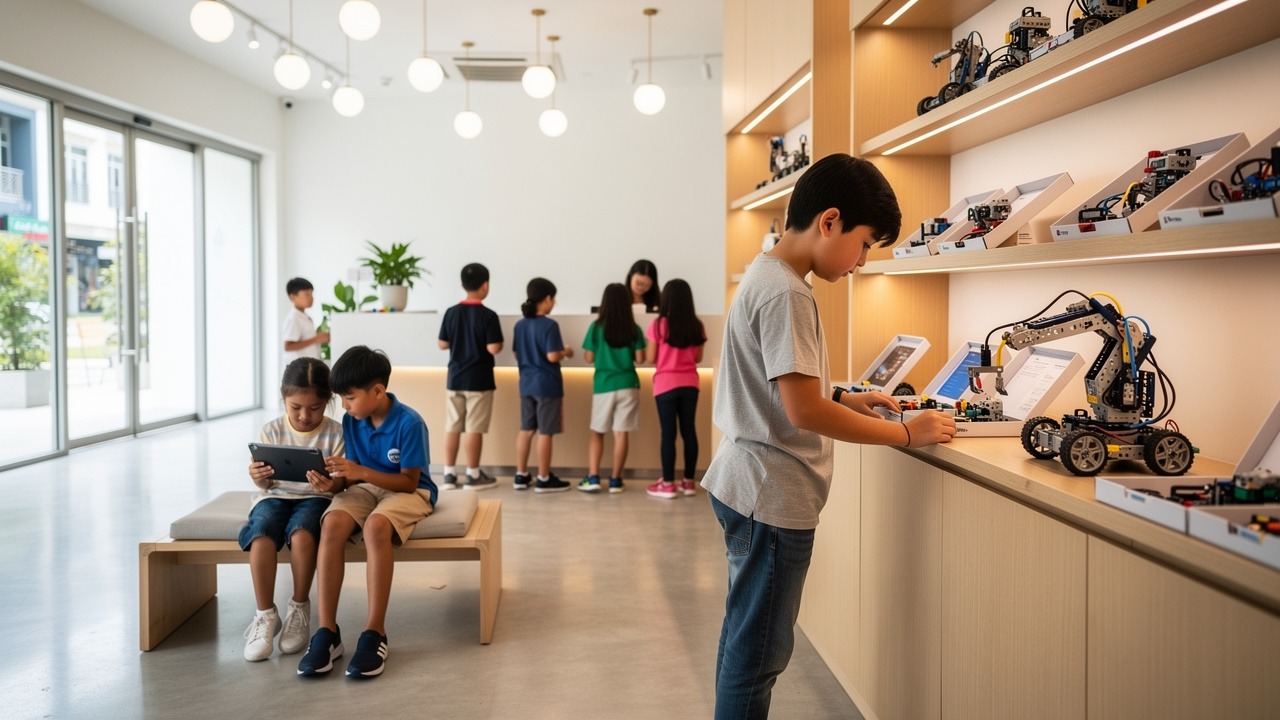
STEM education programs in Singapore stretch from preschool classes to executive courses for senior leaders. This range lets families and businesses pick options that match age, schedule, and career needs. The main paths fall into four broad groups:
- School‑based offerings
- Enrichment for kids and teens
- Formal diplomas and degrees
- Short courses and upskilling for adults
Within schools, the Ministry of Education supports Applied Learning Programmes that weave STEM themes into regular lessons. Science Centre Singapore and A*STAR link schools to research projects and fairs, so students see how science and engineering look beyond textbooks. According to the OECD, this mix of strong classrooms and outside programs helps keep Singapore near the top in global science and math scores.
Specialist enrichment centres fill another gap. Meta Robotics, for example, runs weekly robotics, coding, and STEM classes for ages three to sixteen across centres in Bukit Timah, Jurong East, Katong, Novena, Punggol, Tiong Bahru, and Upper Thomson. Other providers run holiday camps where children spend three to five days on game design, 3D printing, or app projects. These settings often keep classes small, which gives each child more direct guidance.
For teens and adults, polytechnics and universities such as NUS, NTU, SMU, SUTD, and SIT offer diplomas and degrees in engineering, computing, and data. Working professionals can take modular courses in data analytics, AI, and cybersecurity through polytechnics, private academies, or platforms like Coursera and edX that partner with local schools. SkillsFuture Singapore lists many of these on the MySkillsFuture portal, with credits that citizens aged twenty‑five and above can use to offset fees.
SMEs also sit inside this picture. Schemes such as the SkillsFuture Enterprise Credit give each eligible firm up to ten thousand Singapore dollars to support staff training. Workforce Singapore and IMDA run TeSA programs and the Digital Leaders Programme, which help companies build in‑house tech skills. Together, these options make STEM training accessible whether you are a parent choosing a robotics class or a founder planning data training for your team.
Tip For Families: Start with a level that your child finds slightly challenging but still fun. Consistency over months matters more than picking the “most advanced” class on day one.
How Can SMEs And Business Leaders Use STEM Education For Growth?

STEM education matters to SMEs because it links directly to revenue, cost control, and hiring strength. When your team understands data, automation, and testing, everyday decisions stop feeling like guesswork. STEM skills help staff read dashboards, question numbers, and suggest experiments that raise conversion rates or cut wasted ad spend.
One clear benefit is better use of analytics. Data‑literate marketers can read Google Analytics, Meta Ads Manager, or Shopify reports without waiting on an outside analyst. They spot which audiences respond, which search terms bring high‑value buyers, and which pages slow sales. Research from the World Economic Forum notes that companies that invest in advanced data skills see higher productivity than peers that lag in this area. When staff pick up those skills through a STEM‑style course, campaign reviews become sharper and less emotional.
STEM education also feeds your hiring pipeline. Firms that partner with polytechnics, universities, or centres such as Meta Robotics signal that they value technical curiosity. Interns or junior staff who grew up with robotics and coding adapt faster to tools like CRM systems, marketing automation suites, or BI dashboards. Over time this reduces the cost of onboarding and cuts mistakes in data handling.
Marketing for STEM providers and tech‑driven SMEs calls for the same mindset. For STEM providers and tech-driven SMEs, clear communication matters because parents and professionals need to understand what the programme teaches, who it is for, and what outcomes it supports. STEM organisations should also track how families discover their programmes, which content drives enquiries, and which messages help parents make confident decisions. Good outreach should explain the curriculum, age suitability, learning outcomes, trial options, and long-term benefits in a way that parents and business leaders can easily understand.
For business leaders who want accountability, the same principle applies to STEM training: define clear goals, measure progress, and review whether the programme improves skills, confidence, productivity, or lead quality. When that level of discipline meets a strong STEM education program, you get both a better trained workforce and a marketing engine that keeps classes full and revenue steady.
Start With One Decision: Choose A STEM Program Built For Real-World Impact

Choosing the right STEM partner shapes more than a child’s grades or an employee’s résumé. The right program builds habits, confidence, and skills that follow learners into polytechnic labs, university lecture halls, and company meeting rooms. For business owners, those same choices shape how ready your future hires and current staff are for data‑heavy work.
When you weigh options, look closely at:
- Curriculum quality and project depth
- Age fit and progression between levels
- Instructor experience and class size
- Support for grants such as SkillsFuture credits or the SkillsFuture Enterprise Credit
Meta Robotics, for example, offers a clear ladder from Adapter to King Programme so parents can see how skills grow step by step. Checking how each provider tracks progress and communicates with families will help you match a child to the right level.
For SME leaders, STEM is not only a school topic. It is a growth strategy that improves decision‑making, hiring, and innovation. If you run or support a STEM education programme in Singapore, clear communication about curriculum, outcomes, and progression can help families and professionals choose the right learning path with confidence.
Frequently Asked Questions
Question 1: What age should a child start a STEM education program?
Children can start a STEM education program as early as three years old. At that age, programs like Meta Robotics’ Adapter Programme use LEGO® play to build fine motor control and early math ideas. The goal is gentle exposure that sparks curiosity and comfort with science themes.
Question 2: Are STEM education programs in Singapore eligible for government funding?
Many adult‑focused STEM courses qualify for SkillsFuture Credit for citizens aged twenty‑five and above. SMEs can also use the SkillsFuture Enterprise Credit, which offers up to ten thousand dollars per firm, plus TeSA schemes for tech roles. Children’s enrichment programs and adult courses follow different approval paths, so always check each provider’s funding status.
Question 3: How is a STEM enrichment program different from school‑based STEM lessons?
School‑based STEM lessons follow a national syllabus with fixed time and exam pressure. Enrichment academies often offer more hands‑on projects, flexible pacing, and smaller classes. Centres like Meta Robotics track each child’s progress through levels, which allows steady skill growth beyond what weekly school lessons can cover.