
Enrichment Classes Singapore: Parent Guide to Robotics and Coding 2026
Enrichment classes in Singapore are structured activities that extend a child’s learning beyond the regular school curriculum. They can include languages, music, arts, sports, communication, chess, coding, robotics and other STEM activities. The right programme depends less on choosing the most impressive class and more on finding one that fits the child’s age, interests, learning needs and weekly schedule.
A worthwhile enrichment class should give children opportunities to explore ideas, practise useful skills, solve unfamiliar problems and discover interests that may receive less attention during normal school lessons.
For families interested in technology, robotics and coding can offer an unusually broad form of enrichment because children do not only listen or complete worksheets. They build, programme, test, make mistakes, adjust their ideas and see the result directly.
Meta Robotics provides an age-based robotics and coding pathway for children from approximately ages 3 to 16 in Singapore. Its programmes progress from early hands-on STEM exploration to robotics, coding, games and animation, machine learning and more advanced technology projects. The academy uses its NEBULA™ Neuro-Builder learning model to encourage children to plan, construct, code, evaluate and refine solutions rather than simply memorising instructions.
This guide explains what enrichment classes are, how enrichment differs from tuition, what types of programmes parents can consider, how robotics and coding change with age, how much enrichment is too much and how to judge whether a programme is genuinely helping your child.
Key Takeaways
The best enrichment class is not necessarily the most advanced or expensive one. It is the programme that gives a child an appropriate level of challenge while leaving enough space for school, rest, family life and unstructured play.
Enrichment and tuition serve different purposes. Tuition usually supports performance in subjects already taught at school, while enrichment generally broadens or deepens a child’s experience through areas such as arts, sports, communication, languages or STEM.
For robotics and coding, age matters because a preschooler should not be learning in the same way as an upper-primary student or teenager. Younger children benefit from construction, patterns, spatial awareness and simple sequencing, while older students can gradually move towards coding logic, engineering projects, machine learning, competitions and greater independence.
Parents should judge a programme by the learning process rather than the appearance of the final project. A child who can explain what went wrong, why a change was made and how the solution improved is usually demonstrating deeper learning than a child who has simply copied an impressive model.
What Is an Enrichment Class?

An enrichment class is a structured learning experience designed to develop knowledge, abilities or interests beyond a child’s normal school lessons.
The purpose is not necessarily to teach something that will appear in an examination. Enrichment can give children more time to explore a subject, apply ideas practically, develop confidence or discover an area they genuinely enjoy.
A robotics enrichment class, for example, may combine construction, coding, engineering, mathematics, experimentation, communication and teamwork within a single lesson.
A child might begin by understanding a challenge, build a mechanism, programme its behaviour, observe what goes wrong and then improve the result.
Unlike a worksheet that often has one expected answer, a robotics challenge may have several possible solutions.
That uncertainty is part of the learning.
What Types of Enrichment Classes Are Available in Singapore?
Singapore families can choose from a wide range of enrichment activities, and each category develops children in different ways.
Academic and language enrichment may include mathematics, science, English, Chinese and other language programmes designed to deepen understanding or extend learning beyond the school syllabus.
Creative enrichment includes music, art, dance, drama, creative writing and other activities that allow children to express ideas, develop technique and build confidence through performance or creation.
Physical enrichment includes swimming, martial arts, football, gymnastics, dance and other sports that develop coordination, fitness, discipline and teamwork.
Communication-focused programmes may include speech and drama, debate, public speaking and presentation skills.
Strategy-based activities such as chess develop planning, pattern recognition and decision-making.
STEM enrichment includes coding, robotics, engineering, science experiments and technology projects. These programmes are particularly suitable for children who enjoy understanding how things work, building, experimenting, games, puzzles or solving problems through trial and error.
No category is automatically better than another. The right choice depends on what the child needs and enjoys.
How Is Enrichment Different From Tuition?
Tuition generally aims to improve performance in a school subject.
A child may attend tuition because they need additional explanation, more practice, help with examination techniques or support keeping pace with the syllabus.
Enrichment has a different primary purpose. It gives children experiences that broaden or deepen their abilities beyond routine school requirements.
In a robotics class, for example, students may use mathematics and science concepts, but the objective is not normally to practise examination questions. They apply those concepts while building and programming a working project.
The distinction is not always completely clear.
A mathematics enrichment programme may extend mathematical thinking beyond the syllabus while still improving school performance. A coding class may strengthen logical reasoning that later helps with mathematics.
Parents should therefore examine what actually happens during the lessons rather than relying only on whether a provider calls the programme “tuition” or “enrichment.”
Neither approach is automatically better. A child struggling significantly with schoolwork may benefit from academic support, while another child who is coping well but wants a fresh challenge may benefit more from enrichment.
Are Enrichment Classes Worth It?
An enrichment class is worth the time and cost when it adds something meaningful to a child’s development.
That value may appear as a new skill, stronger confidence, deeper curiosity, better perseverance, greater independence or a genuine long-term interest.
The class does not have to produce competition medals or examination results to be useful.
However, parents should be cautious about filling every free afternoon simply because an activity sounds educational.
A programme becomes less valuable when the child is constantly exhausted, attending reluctantly, losing sleep or rushing directly from one structured activity to another with no time to recover.
The question is therefore not simply, “Is this enrichment class good?”
A better question is, “Is this particular class useful for my child at this particular stage?”
Which Enrichment Class Suits Your Child?
Age is one starting point, but personality and interests matter too.
A child who enjoys storytelling and performing may thrive in drama. A child who loves movement may benefit from sport or dance. A child fascinated by patterns may enjoy mathematics or chess.
Robotics and coding can suit children who like building, puzzles, technology, games, experimentation or understanding why things work.
However, children do not need to already be “good at maths” or naturally technical before trying robotics.
A good beginner programme should teach them how to approach the activity rather than expecting existing expertise.
Parents should also distinguish between a child who does not enjoy one particular class and a child who dislikes the subject itself. Sometimes the difficulty level, teaching style or environment is the mismatch rather than the activity.
This is why a trial class can be useful before making a longer commitment.
Why Are Robotics and Coding Useful Enrichment Activities?
Robotics combines thinking with physical action.
Children do not simply imagine what a solution should do. They have to build it and test whether the result matches their idea.
A robot that turns too early, a mechanism that collapses or a programme that fails to respond provides immediate feedback.
The student then has to work out what happened and decide what to change.
This encourages children to break larger problems into smaller parts, recognise patterns, follow logical sequences, test assumptions and persist when the first attempt fails.
Coding adds another layer.
Children learn that computers, games and robots behave according to instructions. If the outcome is wrong, the logic, sequence or design may need to change.
This is one reason robotics and coding can provide broad enrichment within a single activity. Students can encounter science, mathematics, construction, design, coding, communication and creative problem-solving without treating each area as completely separate.
What Age Should Children Start Robotics Enrichment?
There is no universal best age because appropriate robotics education changes substantially as children develop.
A preschooler should not be expected to approach robotics in the same way as a ten-year-old.
The programme should match the child’s fine motor skills, attention span, reading ability, logical understanding and confidence.
Meta Robotics structures its regular programmes by age through Adapter, Ranker, High Ranker, Ace and King levels.
Ages 3 to 4: Adapter Programme
At ages 3 to 4, enrichment should remain highly hands-on.
Children at this stage are developing fine motor control, visual-spatial awareness, language, social interaction and the ability to follow increasingly complex instructions.
Meta Robotics’ Adapter Programme uses guided activities to introduce younger children to early STEM concepts.
The objective is not to turn a three-year-old into an independent programmer.
A more realistic goal is helping children recognise patterns, manipulate objects accurately, understand simple cause and effect and become comfortable attempting small problems.
At this age, enjoyment and curiosity matter more than technical complexity.
A worthwhile lesson should encourage the child to touch, build, compare and experiment rather than spend long periods listening.
Ages 5 to 6: Ranker Programme
Children aged 5 to 6 can begin connecting physical construction with simple coding ideas.
Meta Robotics’ Ranker Programme introduces robotics, STEM, coding, games and animation while building foundational science, mathematics, coding and design skills.
Children begin understanding that instructions happen in sequence and that changing an instruction can change the result.
They may also begin learning that a project does not always work on the first attempt.
That experience matters.
Instead of immediately asking an adult to fix everything, children can gradually learn to look at what happened, compare the result with what they expected and try another solution.
This is the beginning of debugging and iterative problem-solving.
Ages 7 to 9: High Ranker Programme
Between ages 7 and 9, children can usually manage longer projects, more structured logic and greater independence.
Meta Robotics’ High Ranker Programme integrates Robotics STEM, Robotics Coding and Games and Animation Computing. It connects science, mathematics, coding and design through related activities.
Students at this stage can begin using coding ideas such as sequences, repeated actions, conditions and programmed responses more intentionally.
They can also start making more decisions themselves.
The important developmental shift is moving gradually from “tell me the next step” towards “let me decide what I should try next.”
A good class should still provide guidance, but the instructor should not solve every problem before the student has had a chance to think.
What Enrichment Is Suitable for Ages 10 to 12?
Upper-primary students can handle technology projects involving several ideas at the same time.
Meta Robotics’ Ace Programme for ages 10 to 12 combines Robotics STEM, Robotics Coding, Machine Learning and Games and Animation Computing. The programme develops science, mathematics, coding, design, technology and problem-solving through integrated projects.
At this stage, a task might require students to design a physical mechanism, decide what the code should do, interpret information from sensors and adjust the final behaviour after testing.
Students can also begin documenting their projects more meaningfully.
Being able to explain what they attempted, what failed, what they changed and why the final solution improved helps deepen understanding.
This is also an age when individual interests often become clearer.
One child may become particularly interested in programming. Another may prefer physical engineering. Another may enjoy competition challenges, machine learning concepts or creative game design.
A good enrichment pathway should leave room for those interests to develop.
What Should Enrichment Look Like for Teenagers?
Teenagers need increasing depth and independence if an enrichment programme is going to remain worthwhile.
Meta Robotics’ King Programme is designed for students aged 13 and above and integrates science, mathematics, coding, design and evolving technology.
At this age, students should not spend every lesson reproducing highly guided models.
They need opportunities to analyse problems, make design decisions, test alternatives and justify why one solution works better than another.
More advanced robotics can also help teenagers see how technical fields interact.
Mechanical design affects movement. Programming determines behaviour. Mathematics can influence measurement and accuracy. Communication becomes important when students need to explain or present a project.
The goal is gradually moving from following technology towards understanding and creating with it.
What Is the NEBULA™ Learning Model?
Meta Robotics’ NEBULA™ Neuro-Builder model is designed around the idea that children learn more deeply when thinking and doing happen together.
The academy currently describes the model through a 5C developmental framework combined with Spiral Learning.
The first stage is Conceptualize. Students study the challenge, break the problem into smaller parts and consider how they might approach it before beginning the build.
The second stage is Construct. Students assemble mechanisms and structures, applying spatial reasoning and practical engineering skills.
The third stage is Code. Students translate the intended behaviour into instructions, introducing sequencing, abstraction and computational thinking.
The fourth stage is Compute. Students review how the project performs, identify weaknesses and make adjustments.
The fifth stage is Compete. Students demonstrate or run the final solution, helping them practise communication, confidence and performance under challenge.
The value of the framework is not the labels themselves. It is the learning habit behind them.
Students are expected to think before building, test what they have created and improve it rather than assuming the first attempt must be correct.
What Is Spiral Learning?
Meta Robotics also uses Spiral Learning within the NEBULA™ model.
Instead of teaching a concept once and leaving it behind, students revisit robotics, coding and STEM ideas through new challenges of increasing complexity.
A concept learned in a simple project may therefore return later in a more complicated context.
This matters for long-term enrichment.
Without progression, children may spend several years producing different-looking projects while practising essentially the same beginner skills.
Parents should look for evidence that the programme increases the amount of reasoning, independence and technical complexity over time.
What Should Parents Look for During a Trial Class?
A trial lesson can reveal far more than a programme brochure.
Watch how much time the child spends actively building, coding, testing or discussing compared with simply watching the instructor.
Observe what happens when something goes wrong.
Does the teacher immediately provide the answer, or does the child receive enough guidance to investigate the problem first?
Look at whether the difficulty level fits the child.
A class that is too easy may be entertaining without producing much growth. A class that is too difficult may turn every task into frustration.
After the lesson, avoid asking only, “Was it fun?”
Ask what problem the child had to solve.
Ask what did not work.
Ask what they changed.
Ask what they would do differently next time.
Those answers reveal much more about the quality of the learning experience.
What If My Child Already Has Robotics or Coding Experience?
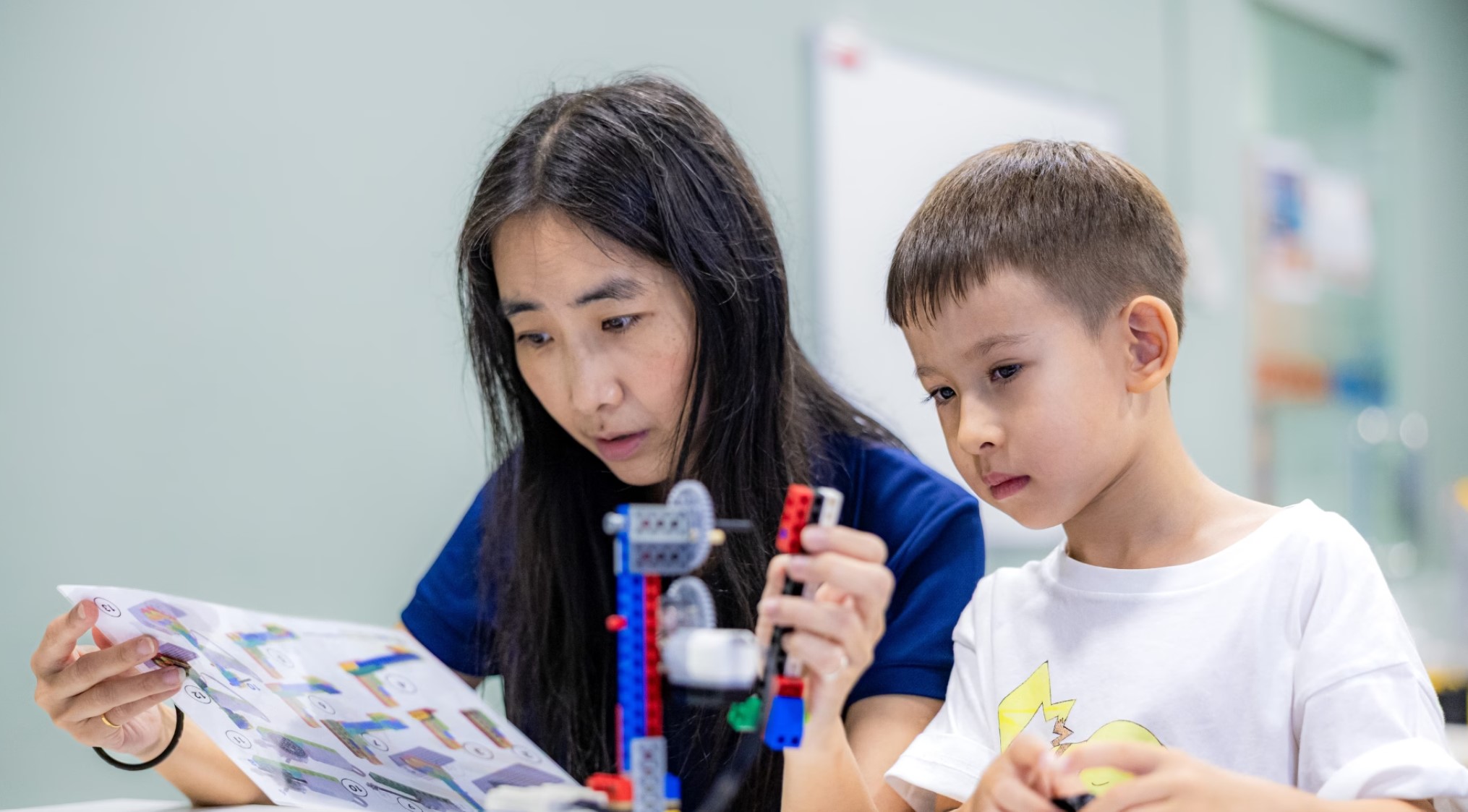
Age bands are useful, but they should not be treated as rigid ability levels.
An eight-year-old who has spent several years coding and building independently may need a different level of challenge from another eight-year-old attending a robotics class for the first time.
Prior experience matters, but so does independence.
A child may know many coding blocks yet still depend heavily on step-by-step instructions. Another beginner may understand new concepts unusually quickly.
Parents should therefore ask whether the provider can assess the child during a trial or initial session and recommend an appropriate entry point.
The right programme should challenge what the child can already do rather than simply matching the birthday on the registration form.
How Much Do Enrichment Classes Cost in Singapore?
There is no single meaningful price for every enrichment class because programmes differ substantially in duration, equipment, instructor involvement, group size and specialist content.
Parents should therefore compare value rather than looking only at the headline fee.
A robotics programme using specialised educational equipment may have a different cost structure from an art lesson or language class.
Class size can also affect price. Smaller groups may involve more individual instructor attention, while larger classes may cost less but offer less personalised support.
The lesson duration and total number of classes in a term matter as well.
When comparing programmes, consider the total term cost, number of lessons, duration of each lesson, materials provided, replacement-class policy, trial fees and whether competitions, examinations, equipment or registration involve additional charges.
A lower price is not automatically better value if the programme lacks progression or meaningful instructor interaction.
Likewise, a higher fee does not guarantee stronger teaching.
Parents should understand what the child actually receives for the total commitment.
How Many Enrichment Classes Should a Child Take?
There is no ideal number that works for every family.
A timetable should leave enough space for school, sleep, meals, family time, friendships and unstructured play.
A child taking tuition, music, robotics, sport and several other activities may technically have many opportunities but very little time to process them.
Warning signs of overload can include regular resistance before classes, persistent tiredness, reduced sleep, unfinished schoolwork and losing enthusiasm for activities the child previously enjoyed.
Parents should also remember that one well-designed enrichment programme can develop several areas simultaneously.
Robotics, for example, may already involve STEM, coding, construction, creativity, teamwork and communication.
There is no need to assign a separate class to every developmental goal.
A sustainable timetable is usually more useful than an impressive one.
Can Robotics Enrichment Support DSA-Sec Preparation?
Robotics, coding and engineering experience may support DSA-Sec applications to relevant talent areas when a student develops genuine ability and the individual secondary school’s criteria align with that experience.
MOE states that Primary 6 students can apply for DSA-Sec based on talents including Science, Mathematics and Engineering, alongside other talent areas. Schools offer different programmes and use their own selection processes.
This means there is no universal rule saying that attending a robotics class automatically creates a DSA pathway.
Meta Robotics currently offers a dedicated 45-hour DSA programme for students aged 9 to 12 covering robotics, coding, STEM, project work, portfolio development and preparation for competitions such as FIRST LEGO League and World Robot Olympiad.
The programme can support skill development, but completing it does not guarantee admission.
A strong DSA portfolio should show more than certificates.
Students should be able to explain the project, what they contributed, which problem occurred, how the solution was improved and what they learned.
Competition participation may form part of a student’s experience, but the child should understand the work well enough to discuss it independently.
Preparation is therefore more meaningful when it develops naturally from genuine interest rather than becoming another last-minute academic obligation.
Are Holiday Enrichment Workshops Worth Trying?
Holiday workshops can be useful when parents want to test a child’s interest before committing to regular weekly classes.
Meta Robotics currently offers holiday workshops for children aged 5 to 13. Its published format runs across three days, with students completing two projects per day for a total of six projects during the workshop.
A shorter programme gives children exposure to several activities within a concentrated period.
It can also help parents see which part of the experience attracts the child.
One student may enjoy physical construction. Another may spend more time adjusting the code. Another may enjoy working with classmates to solve the challenge.
Holiday workshops and weekly lessons serve slightly different purposes.
A workshop offers concentrated exposure and can help test interest. Weekly classes provide more time for concepts to be revisited, extended and developed progressively.
Parents should choose according to the goal rather than assuming one format is automatically better.
How Do You Know Whether an Enrichment Class Is Actually Helping?
Progress should be visible in the way a child thinks, not only in the projects they bring home.
A child who once gave up immediately may begin trying a second approach.
A child who previously waited for instructions may begin suggesting a solution.
A child who could only say “the robot didn’t work” may gradually learn to explain which part failed and why.
These changes may appear small, but they show the development of learning habits.
Ask your child about the process instead of only the result.
“What was difficult today?”
“What did you change?”
“How did you know that was the problem?”
“What would you try next?”
Children who can increasingly answer those questions are demonstrating genuine understanding.
Why Consider Meta Robotics for STEM Enrichment?
Meta Robotics focuses specifically on robotics, coding and STEM enrichment for children from approximately ages 3 to 16.
Its regular age-based pathway allows children to progress through Adapter, Ranker, High Ranker, Ace and King programmes rather than remaining indefinitely at beginner level.
The curriculum uses the NEBULA™ model, combining its five-stage Conceptualize, Construct, Code, Compute and Compete learning cycle with Spiral Learning.
Meta Robotics also offers progress updates, digital programme milestones, holiday workshops and a separate DSA preparation pathway.
This makes it one possible option for families specifically looking for technology-focused enrichment rather than a general enrichment provider.
Parents should still judge the programme according to their child’s interests, current ability, schedule and response during a trial lesson.
Where Can Families Attend Meta Robotics Classes?
Meta Robotics currently lists seven centres across Singapore.
They are located in Bukit Timah at Beauty World Centre, Jurong East at Jurong Gateway Road, Katong at Katong V, Novena at Goldhill Shopping Centre, Punggol at Punggol Plaza, Tiong Bahru at Jalan Bukit Ho Swee and Upper Thomson at Thomson V Two.
Location deserves serious consideration for a weekly enrichment programme.
A slightly shorter journey every week can make consistent attendance much easier over several terms.
Families should confirm the latest programme availability and timetable at their preferred centre before registering because schedules may vary by location.
Frequently Asked Questions About Enrichment Classes in Singapore
What Is the Difference Between Enrichment and Tuition?
Tuition generally focuses on improving performance in school subjects through explanation, practice and syllabus support. Enrichment usually broadens or deepens learning through areas such as languages, arts, sports, communication, coding or robotics. Some programmes overlap both categories, so parents should examine the actual learning objectives rather than relying only on the label.
Are Enrichment Classes Worth the Money?
They can be worth the cost when the child develops meaningful skills, confidence, curiosity or sustained interest. Value depends on programme quality, instructor interaction, progression and whether the activity fits the child. An expensive programme is not automatically better, and an overloaded timetable can reduce the benefit of even a good class.
How Many Enrichment Classes Are Too Many?
There is no fixed number. The timetable becomes excessive when structured activities begin affecting sleep, school responsibilities, rest, family time or the child’s willingness to participate. A sustainable schedule with one or two meaningful activities can be more useful than filling every available afternoon.
How Do I Choose an Enrichment Class for My Child?
Start with the child’s interests, developmental stage and current needs. Then evaluate the programme’s progression, instructor involvement, amount of hands-on activity, class difficulty, travel requirements and total cost. A trial lesson can help determine whether the environment and teaching style fit the child.
What Age Can a Child Start Robotics Enrichment?
Meta Robotics offers its earliest programme from ages 3 to 4, followed by Ranker for ages 5 to 6, High Ranker for 7 to 9, Ace for 10 to 12 and King for ages 13 and above. The appropriate starting point should still depend on the child’s readiness and previous experience.
Does My Child Need Coding Experience Before Joining Robotics?
Not necessarily. Beginner programmes should introduce coding and robotics concepts progressively. Prior experience becomes more important when a child is considering a more advanced class, in which case a trial or placement assessment can help determine the appropriate level.
What Do Children Learn in Robotics Enrichment?
Children can encounter construction, robotics, coding, science, mathematics, design, computational thinking, creativity and problem-solving through hands-on projects. The content becomes progressively more complex as students grow and gain experience.
Is Robotics Suitable for a Child Who Does Not Like Mathematics?
It can be. Robotics uses mathematical ideas, but children encounter them within practical challenges rather than only through written exercises. Some children who do not enjoy traditional mathematics may still enjoy building, coding or problem-solving. A trial class is the best way to judge the individual child’s response.
Can Robotics Enrichment Help With DSA-Sec?
Robotics, coding and engineering experience may support applications to relevant DSA-Sec talent areas, depending on the secondary school’s published criteria. MOE lists Science, Mathematics and Engineering among the broad DSA-Sec talent areas, but each school uses its own selection process. Meta Robotics offers a separate 45-hour DSA programme for ages 9 to 12, but participation does not guarantee admission.
Should My Child Choose Weekly Classes or a Holiday Workshop?
A holiday workshop can be useful for testing interest or giving a child concentrated exposure during the school break. Weekly classes are generally better suited to gradual skill progression because concepts can be revisited and extended over time. The right format depends on whether the family wants exploration or sustained development.
Where Are Meta Robotics Classes Available in Singapore?
Meta Robotics currently lists centres in Bukit Timah, Jurong East, Katong, Novena, Punggol, Tiong Bahru and Upper Thomson. Families should confirm the current timetable and programme availability at their preferred centre before registering.
Conclusion
Choosing enrichment classes in Singapore becomes easier when parents stop asking which programme looks the most impressive and instead consider what the child actually needs.
Enrichment can take many forms, including languages, arts, sports, communication, strategy games and STEM.
The right activity should broaden the child’s experience without making the weekly timetable unsustainable.
Robotics and coding can be particularly useful for children who enjoy building, experimenting, games, technology, puzzles or understanding how systems work because one activity can combine construction, mathematics, science, coding, creativity, communication and problem-solving.
Meta Robotics provides an age-based robotics and coding pathway from preschool through the teenage years, guided by its NEBULA™ 5C framework and Spiral Learning approach. Children can progress from basic hands-on exploration into coding, robotics projects, games and animation, machine learning, competitions and more advanced technology.
The best programme is not necessarily the most advanced one.
It is the class that gives a child the right amount of challenge at the right stage while leaving enough space to rest, play and remain curious.
When children begin approaching unfamiliar problems with curiosity, testing ideas instead of fearing mistakes and explaining how they reached a solution, enrichment is doing something much more valuable than simply keeping them occupied after school.