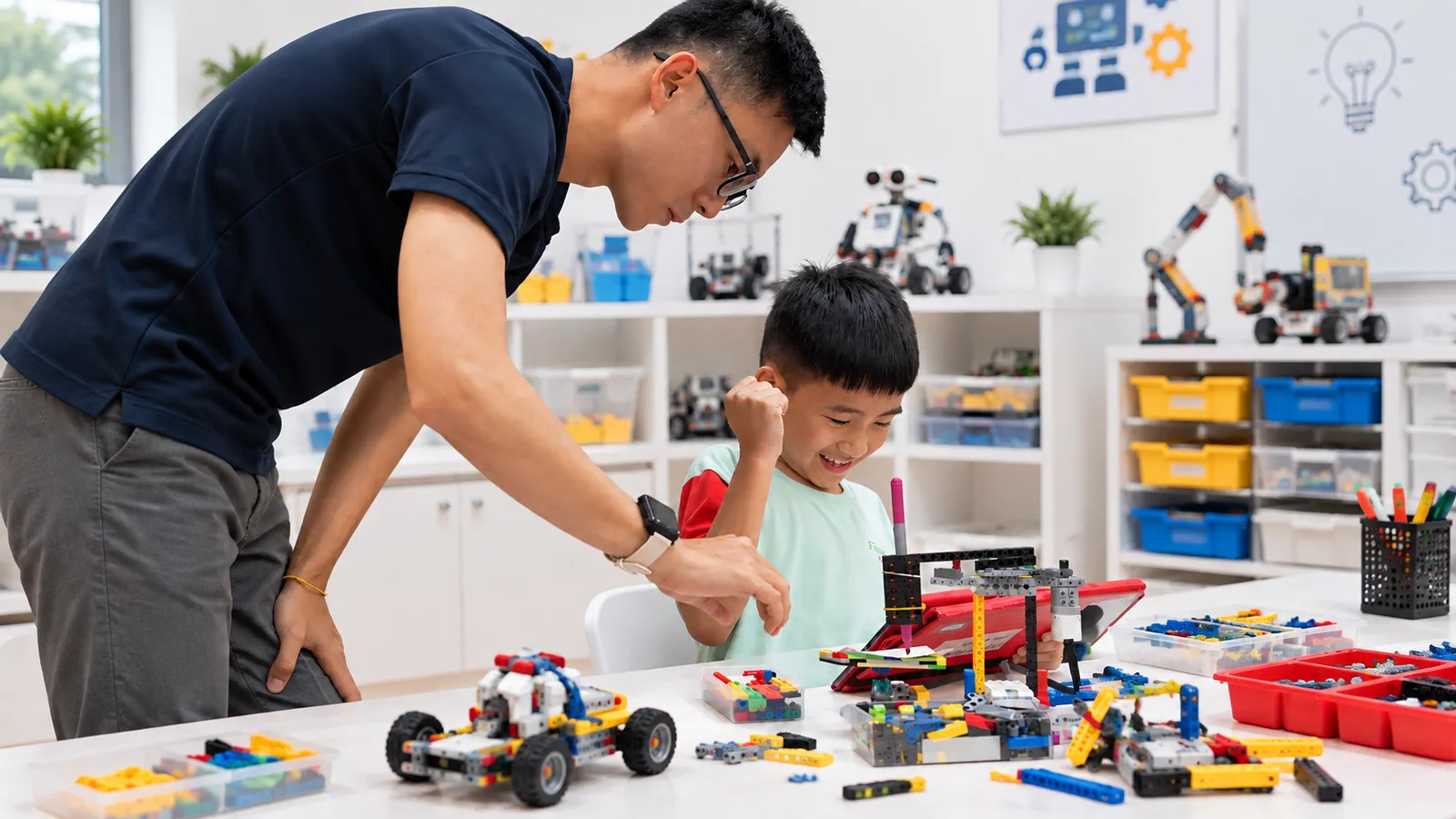
Many children enjoy building with LEGO bricks. LEGO robotics and coding adds programmable movement, sensors and hands-on problem-solving.
This guide explains what LEGO robotics involves, when children can start, what they learn and how to choose a suitable programme.
What is LEGO robotics and coding?
LEGO robotics combines building elements with programmable motors, sensors and a controller. Children construct a model, then use compatible software to give it instructions. The experience can connect engineering, coding, mathematics and science through age-appropriate projects.
LEGO building vs LEGO robotics: what’s the difference?
| Feature | LEGO building | LEGO robotics |
|---|---|---|
| Main activity | Constructing models | Building and programming functional models |
| Movement | Manual or mechanical | Programmable motors |
| Coding | Not required | Compatible programmable kits |
| Learning focus | Creativity and spatial reasoning | Construction, programming, testing and engineering |
How does LEGO robotics work?
Build
Children assemble a model with components such as wheels, gears, motors, sensors and a controller.
Program
They create instructions using compatible software, often visual blocks for beginners.
Test
They run the programme and observe whether it moves, stops and responds as intended.
Improve
They investigate unexpected results, adjust the design or programme, and test again. This build, programme, test and improve cycle is central to robotics learning.
What age can children start LEGO robotics?
| Age | Suitable learning experiences |
|---|---|
| 3–4 | Construction, simple mechanisms, patterns and cause-and-effect |
| 5–6 | Guided building, sequencing and introductory robotics |
| 7–9 | Programmable models, motors, sensors and beginner challenges |
| 10–12 | Mechanisms, programming logic and independent projects |
| 13+ | Advanced robotics and open-ended technical challenges |
These are broad guidelines. Follow the specific kit’s age and safety guidance.
What do kids learn through LEGO robotics?
- Logical thinking and sequencing: organising commands and considering each step.
- Problem-solving: investigating possible causes and testing ideas.
- Engineering and design thinking: understanding how construction affects performance.
- Creativity: exploring alternative structures and solutions.
- Perseverance and debugging: observing results, forming explanations and improving.
- Communication and teamwork: discussing designs and explaining decisions.
What coding concepts can children learn?
| Concept | Robotics example |
|---|---|
| Sequencing | Move forward, turn, then stop |
| Loops | Repeat a movement pattern |
| Events | Begin when a button is pressed |
| Conditions | Stop when an obstacle is detected |
| Variables | Adjust movement with stored speed |
| Debugging | Correct a robot that turns too far |
Five LEGO robotics projects for beginners
1. Build a moving vehicle
Build a simple motorised vehicle and test speed, distance and stopping near a finish line.
2. Create a robot that avoids obstacles
Use a compatible distance sensor and improve how reliably the robot detects obstacles.
3. Design a lifting mechanism
Explore gears, mechanisms and how a motor can control a steadier lift.
4. Complete a navigation challenge
Programme a route with turns, then test and simplify the instructions.
5. Build a sorting or delivery robot
Create a multi-step robot that moves an object to one or more destinations.
Does LEGO robotics require Scratch coding?
Not necessarily. Some robotics environments use block-based programming and may share ideas with Scratch, but not all LEGO robotics products use Scratch itself. The important concepts are sequencing, loops, conditions and debugging.
See our Scratch coding guide for a digital-programming introduction.
LEGO robotics vs coding classes
Robotics combines physical construction and programming; coding-focused classes typically create digital games, animations or applications. Neither is universally better: the right fit depends on whether a child enjoys building, experimentation or digital creativity.
Read our guide to robotics classes for kids in Singapore for a broader comparison.
Can children learn LEGO robotics at home?
Yes, with suitable equipment, guidance and a safe environment. Begin with a simple, age-appropriate project, follow manufacturer instructions, and ask children what they predict, why the robot behaved a certain way, and what they could test next.
How to choose a LEGO robotics class in Singapore
- Check the learning objectives.
- Understand how much children build independently.
- Look for meaningful coding activities.
- Evaluate the progression.
- Observe how instructors handle mistakes.
- Ask how progress is communicated.
Is LEGO robotics suitable for children who are not good at mathematics?
Yes. Age-appropriate projects can explore patterns, directions, counting and measurement through practical experiences. Robotics should not be presented as a guarantee of school-mathematics results.
Do children need to join robotics competitions?
No. Competitions are one optional extension; regular projects can develop programming, engineering, creativity and problem-solving.
Exploring robotics and coding at Meta Robotics
Meta Robotics offers hands-on learning pathways from foundational construction and logical thinking through advanced programming and engineering. Specific kits and platforms may vary by current curriculum and programme level.
Explore robotics programmes or the Robotics Discovery Assessment to identify a suitable starting point.
Frequently asked questions
What is LEGO robotics?
It combines compatible LEGO components with programming, motors, sensors and controllers.
What age is suitable?
It depends on the kit and the child’s readiness.
Does it teach real coding?
Suitable systems can introduce sequencing, loops, conditions and debugging.
Is it the same as Scratch?
No. They are different learning environments, though some use related block-based ideas.
Are classes necessary?
No. Classes may provide equipment, progression, guidance and peer interaction.
Does Meta Robotics use LEGO kits?
Confirm current equipment details with the centre before enrolling.
Final thoughts
LEGO robotics brings together building and discovering how things work. By adding programming, children can plan, experiment, investigate mistakes and improve their ideas through hands-on problem-solving.
LEGO® is a trademark of the LEGO Group of companies which does not sponsor, authorize or endorse this site.